Will AI doom or save us?

Every new development is condemned as likely leading to the ruination of what has come before. It's a desire to protect our comforts and memories—combined with the fear of losing power and control to the unknown. Anything that forces us to shift our identity is met with resistance. From Socrates (believing the written word is not an ineffective means of communicating knowledge) down through the printing press, radio, TV, computers, etc., the temptation is to condemn new technology for the very fact it is new and unfamiliar. The other temptation is the opposite (deeming it better simply because it is new and shiny). 

Considering that Riepl’s Law seems to be holding (old technology is not replaced, but fades in importance) and each iteration of technology can be used for good or evil, it seems the best attitude toward technology is to see it is as presenting a both/and situation and not an either/or dilemma. 

Will AI doom/save us? Probably. 

Stephen Goforth
The strongest predictor of men’s well-being

American men (along with their peers in the UK) derive happiness not from traditional notions of power and strength, but from the typically quieter task of doing meaningful work and contributing to the communities around them. That’s the finding of research out of the UK. Leah Fessler has more in Quartz

The best predictor of toxic work culture

To find evidence-based insights on culture change, we began with the large body of existing research on unhealthy corporate culture. Leadership consistently emerged as the best predictor of toxic culture. The importance of leadership will surprise no one, but it does underscore a fundamental reality: Leaders cannot improve corporate culture unless they are willing to hold themselves and their colleagues accountable for toxic behavior.  Toxic social norms can take on a life of their own in a team or an organization and persist through multiple changes in leadership. Without a commitment from the top team, any organization wide culture change — including a cultural detox — is destined to fail. 

Donald Sull and Charles Sull writing for the MIT Sloan Management Review

The 3 Things Far-Right & Far-Left Political News Sources have in Common

When researchers analyzed almost 6,000 political news stories produced by partisan and nonpartisan media outlets in 2021, three things became clear:

  • Media outlets with extreme biases — regardless of whether it was a conservative or liberal bias — tended to use shorter sentences and less formal language than nonpartisan outlets.

  • Mainstream news organizations, as a whole, wrote at a higher reading level.

  • Far-right and far-left outlets took a more negative tone than nonpartisan outlets. They generally had a lower ratio of positive to negative words.

The researchers describe their findings in a paper forthcoming in Journalism Studies, “At the Extremes: Assessing Readability, Grade Level, Sentiment, and Tone in US Media Outlets.”

Read the full article from Journalist’s Resources here.

Worry that Past Failures will Repeat

Worry about the repetition of past problems is not a sign of healthy thinking. True, it indicates a desire to be rid of the possible plenty of repeated pain, but inevitably it represents its own brand of pain. The individual has clearly specified what must - and what must not - be part of his life, but the mind is so obsessed with preventing old problems that satisfaction is not recognized in present situations. The imperative person is a prisoner of the past.

Les Carter, Imperative People: Those Who Must Be in Control

Selfishness and Self-love

If it is a virtue to love my neighbor as a human being, it must be a virtue and not a vice-to love myself since I am a human being too. There is no concept of man in which I myself am not included. A doctrine which proclaims such an exclusion proves itself to be intrinsically contradictory. The idea expressed in the Biblical “Love thy neighbor as thyself!” implies that respect for one’s own integrity and uniqueness, love for and understanding of one’s own self, can not be separated from respect for and love and understanding of another individual. The love for my own self is inseparably connected with the love for any other self.

The affirmation of one’s own life, happiness, growth, freedom, is rooted in one’s capacity to love, i.e., in care, respect, responsibility, and knowledge. If an individual is able to love productively, he loves himself too; if he can love only others, he can not love at all.

The selfish person.. can see nothing but himself; he judges everyone and everything from its usefulness to him; he is basically unable to love. Does not this prove that concern for others and concern for oneself are unavoidable alternatives? This would be so if selfishness and self-love were identical. But.. selfishness and self-love, far from being identical, are actually opposites.

Eric Fromm, Man for Himself

The Process of Transitions

Change is a situational shift.

Getting a new boss is a change, and so is receiving a promotion or losing your job.

Moving to a different house is a change, and so it remodeling your house or losing it in a fire.

Having a new change is a change for everyone in the family—including the new baby, who was pretty well situated before all the change too place.

And, of course, losing a loved one is a change—a huge one.

Transition, on the other hand, is the process of letting go of the way things used to be and then taking hold of the way they subsequently become. In between the letting go and the taking hold again, there is a chaotic but potentially creative “neutral zone” when things aren’t the old way, but aren’t really a new way yet either. This three-phase process—ending, neutral zone, beginning again—is transition.

William Bridges, The Way of Transition

Loose, Messy and Chaotic

Tight ways of thinking and working, while being superficially attractive and comforting, don't work. They have been built on the illusion of control. This illusion – propagated by legions of consultants, economists, market researchers and other purveyors of empirical snake oil – has actually made businesses less capable of embracing the complex realities of the modern world.

Agility, flexibility, a willingness to exercise judgement and an ability to improvise will become the defining characteristics of successful institutions in the next decades. This means fighting the instinct to solve every problem through rules and regulations and recognising the limitations of long-term planning and the painfully slow nature of most internal decision-making processes.

It means accepting the need to operate in real time and making the organisational and cultural changes necessary to achieve it. And most importantly, it means building a strong, self-sustaining, trusting organisational culture rather than in investing in yet more process and bureaucracy.

The future is loose, messy and chaotic: now is the time to embrace it.

Martin Thomas, Loose: The Future of Business is Letting Go

A ChatGPT-assisted academic paper

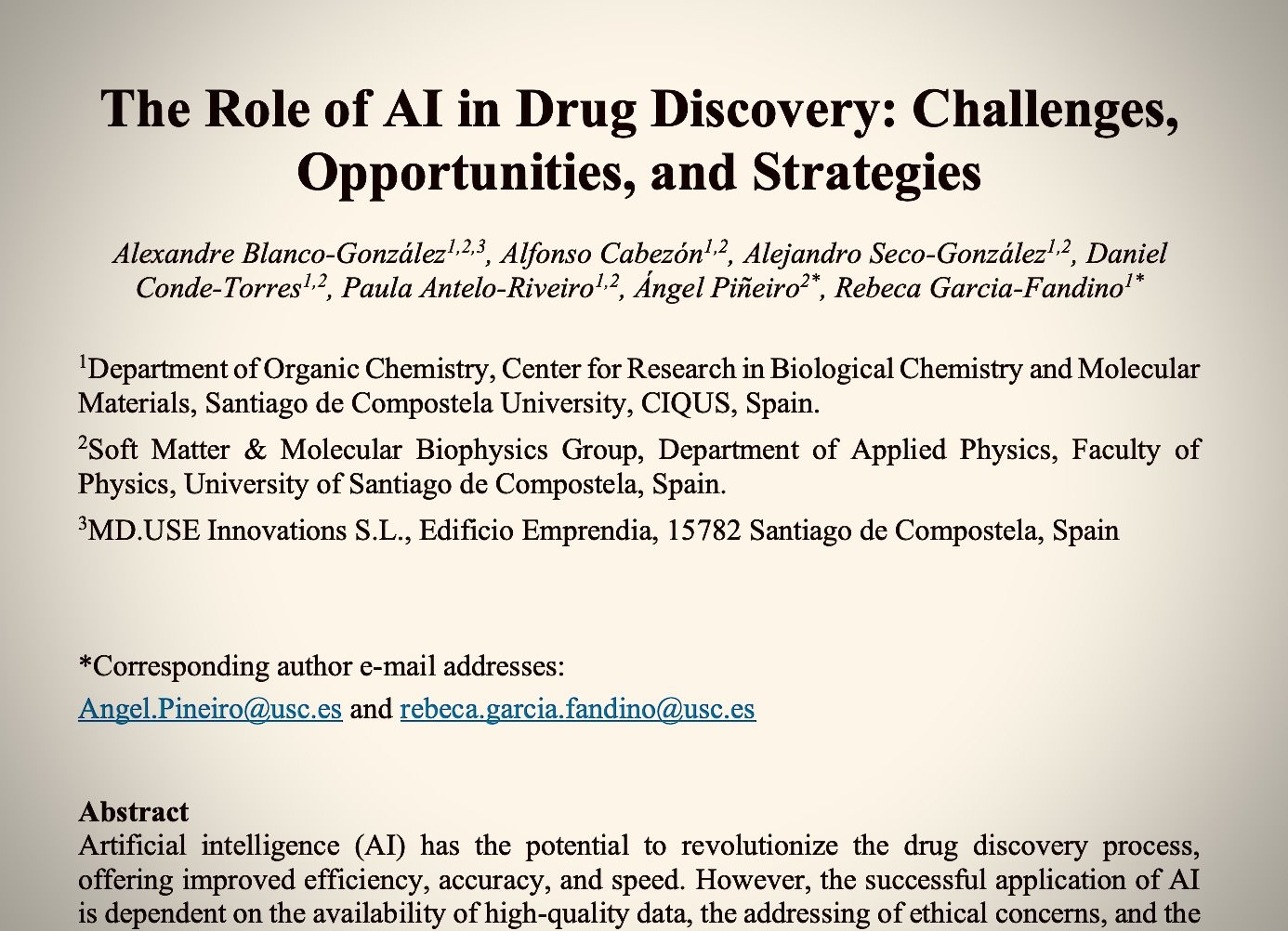
A ChatGPT-assisted paper is posted to the arXiv. The topic is AI use in drug discovery and the authors conclude, “AI has the potential to revolutionize the drug discovery process.”

The paper is an example of how the ChatGPT bot might be used in academic papers and offers a potential model for AI-assistance transparency. Their conclusion:

As a result of this experiment, we can state that ChatGPT is not a useful tool for writing reliable scientific texts without strong human intervention. One of the main reasons why this AI is not yet ready to be used in the production of scientific articles is its lack of ability to evaluate the veracity and reliability of the information it processes. A real risk is that predatory journals may exploit the quick production of scientific articles to generate large amounts of low-quality content. Overall, addressing the risks associated with the use of AI in the production of scientific articles will require a combination of technical solutions, regulatory frameworks, and public education.