There is no security
/There is no security on this earth, there is only opportunity. -General Douglas MacArthur (born Jan. 26, 1880)

Ideas that challenge / comfort / inspire
Stephen Goforth
There is no security on this earth, there is only opportunity. -General Douglas MacArthur (born Jan. 26, 1880)
Large Language Models have demonstrated impressive capabilities in reasoning and planning [but] LLM-based agents continue to fail in complex, multi-step planning tasks. More from a paper published in Arxiv
Life is not about waiting for the storm to pass, it’s about learning to dance in the rain. - Vivian Greene
In a world where AI increasingly mediates access to knowledge, future generations might lose connection with vast bodies of experience, insight and wisdom. AI developers might argue that this is simply a data problem, solvable by incorporating more diverse sources into training datasets. While that might be technically possible, the challenges of data sourcing, prioritization and representation are far more complex than such a solution implies. - Deepak Varuvel Dennisonis
Liquid Foundation Models (LFM) – This type of AI has a smaller memory footprint but packs greater computational power than the transformer models found in most GenAI systems. Using fewer parameters and neurons than transformers, LFMs are designed to handle a variety of sequential data (such as text, video, and audio) with significant accuracy. LFMs do not rely on existing frameworks as transformers do. They are built from the ground up (that is, built on “first principles”).
Sermonizing about goals is change-talk. But not growth-talk. Each has a place and a time, but they are not to be mistaken for each other. We may be fooling ourselves, thinking we are moving forward — when really, on the inside, we are idle, going nowhere.
AI Surveillance Systems Are Causing a Staggering Number of Wrongful Arrests - Futurism
Grok deepfakes accelerate Hill action - Axios
Matthew McConaughey Trademarks Himself to Fight AI Misuse – Wall Street Journal
There’s One Easy Solution to the A.I. Porn Problem – New York Times
Resisting AI slop in Science & Higher Ed – Science.org
A bibliography of genAI-fueled research fraud from 2025 – Sharon Kabel
Publisher under fire after ‘fake’ citations found in AI ethics guide – The Times
Boys at her school shared AI-generated, nude images of her. After a fight, she was the one expelled – Associated Press
Researchers call for retraction of two recent Nature studies about AI-generated crystals – Chemical & Engineering News
More than half of researchers now use AI for peer review — often against guidance – Nature
The rise of deepfake cyberbullying poses a growing problem for schools – Associated Press
This guy’s obscure PhD project is the only thing standing between humanity and AI image chaos – Fast Company
A.I. Videos Have Flooded Social Media. No One Was Ready. - New York Times
How to Spot AI Hallucinations Like a Reference Librarian – Card Catalog for Life
AI Slop Is Spurring Record Requests for Imaginary Journals – Scientific American
More A than I: Testing for Large Language Model Plagiarism in Political Science – Political Science Now
A.I. Videos Have Flooded Social Media. No One Was Ready - New York Times
Three leading chatbots failed to detect fake videos generated by Sora most of the time.
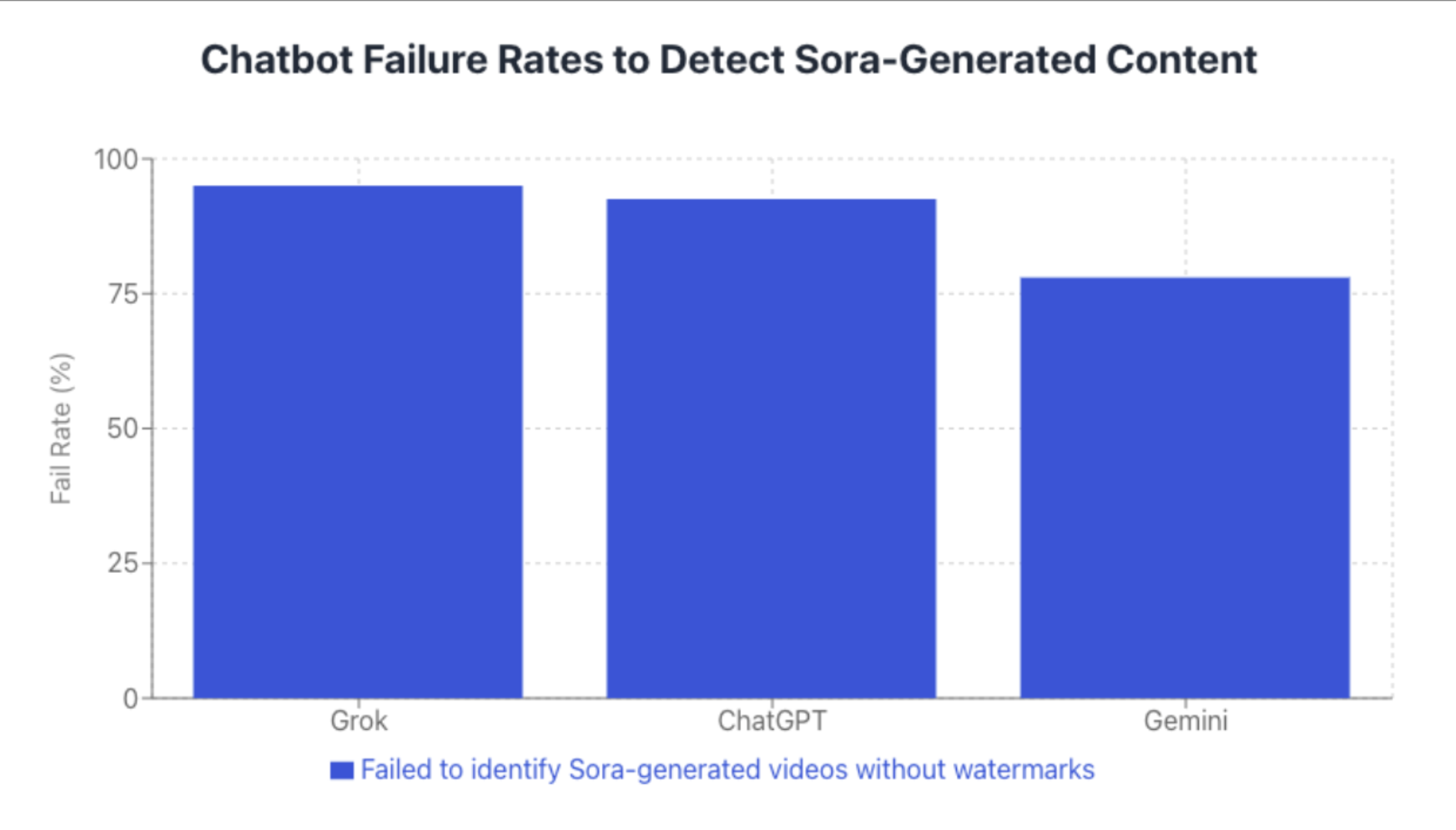
(Graph by NewsGuard)
We grow toward true self in a space where our growth is not driven by external demands but drawn forward, by love, into our best possibilities. -Parker Palmer
Using AI as a Design Engineer – Jakub.kr
The Problem With Letting AI Do the Grunt Work AI is destroying the career ladder for aspiring artists – The Atlantic
8 Ways A.I. Affected Pop Culture in 2025 – New York Times
Universal Music Group and Splice Ink AI Partnership – Hollywood Reporter
AI Is a Gift to Human Creativity When anyone can produce passable work, real talent becomes more readily apparent than ever. – Wall Street Journal
What does it mean to be a designer in the age of AI? - Figma
Inside the Creation of Tilly Norwood, the AI Actress Freaking Out Hollywood - Wall Street Journal
Town’s Christmas art contest ends in scandal: Did the winner use AI? – Washington Post
The Current No. 1 Christian Artist Has No Soul – Christianity Today
AI artists blow up on country music chart – Axios
People can't tell AI-generated music from real thing anymore, survey shows – CBS News
From design to direction: Bridging product design and AI thinking – UX Design
Coca-Cola Injects ‘Holidays Are Coming’ Ads With an Upgraded Dose of AI – Wall Street Journal
More AI actors are in development - Deadline
A handful of creators have been paid more than $1 million to license their videos to AI companies. – Semafor
On AI Removing Creative Constraints – Illusion of More
Using AI for UX Work: Study Guide – NN Group
Reinforcement Learning - Rather than being given specific goals, the AI is deployed into an environment where it can train with minimal feedback. This trial-and-error approach involves adjusting weights until high-reward outcomes are achieved. Desirable behaviors are rewarded, and undesirable behaviors are punished. It is similar to a person learning how to work through levels of a video game, searching for an effective strategy. This type of machine learning sits somewhere in between supervised (by humans) and unsupervised learning. Reinforcement learning is used in video game development and has helped robots adapt to new environments.
A visualization technique that asks people to write their own eulogy. It’s a technique that Daniel Harkavy, co-author of Living Forward, has been teaching executives for over 20 years.
Harkavy’s tip is to write your eulogy first as if your funeral was today and everything you’ve accomplished so far was all you ever would. “Picture your memorial service as if it were being held right now. Your casket is sitting center stage, and as you look down the center aisle you see the first three rows, usually reserved for those with whom we were closest. Who’s sitting there for you?” he asks. “Most likely your family and dearest friends. Now keep looking down the aisle, and now you’re looking at rows 10 through 20. Who’s sitting there? Probably acquaintances, clients, customers. What did you give to the people in these rows?”
Harkavy says when he walks clients through this exercise during his speaking engagements, they usually all say the same thing: “We gave them our best!” He then asks them what they gave to the people sitting in rows one through three–and their answers usually amount to “We gave them our leftovers.” In other words, their work-life balance is out of whack.
“When you go to write your eulogy, you need to be brutally honest. Don’t pull any punches. You want to really feel this,” Harkavy says. “What would those closest to you say about who you were, how you lived, and what you had to give them, and why would they say that?”
Michael Grothaus writing in Fast Company
It should not come as a surprise that a growing body of studies shows how LLMs predominantly reflect Western cultural values and epistemologies. They overrepresent certain dominant groups in their outputs, reinforce and amplify the biases held by these groups, and are more factually accurate on topics associated with North America and Europe. - Deepak Varuvel Dennisonis
On Coding Agents and the Future of Design – Veen
Developers Use AI Coding Tools To Get Started, Not Finish The Job – Forbes
10 things I learned from burning myself out with AI coding agents - ArsTechnica
Anthropic's "infinite vibe coding machine" – Axios
Generative coding: 10 Breakthrough Technologies 2026 – MIT Tech Review
Dramatic drop in Stack Overflow questions as devs look elsewhere for help - DevClass
Vibe Code Reality Check: What You Can Actually Build with Only AI - KDnuggets
“Tinder for Nazis” hit by 100GB data leak, thousands of users exposed with the help of AI – CyberNews
AI Tools Make Coders More Important, Not Less – Harvard Business Review
Finding Meaningful Work in the Age of Vibe Coding - KDnuggets
AI Can Write Your Code. It Can’t Do Your Job. – Terrible Software
As a first-time vibe coder, I wish AI knew when to say no – Rest of World
Millions of Coders Love This AI Startup. Can It Last? – Wall Street Journal
How coding agents speed up the software development lifecycle – Open AI Developers
The New Calculus of AI-based Coding - Joe Magerramov's blog
The Joy of Coding Isn’t Dead, It’s Being Redefined – RT Insights
The real problem with AI coding - Paul Sanglé-Ferrière
Code like a surgeon - Geoffrey Litt
AI Code Is a Bug-Filled Mess – Futurism
Vibe Coding – An LLM generates code that meets the specifications stated in the user's prompt. This is not the same as software development, where the user reviews the AI coding and can explain it. This type of coding uses natural language to communicate desired outcomes. Vibe coding platforms would include Claude Artifacts, Creator Hunter, and Cursor. While the goal is a finished product, in practice, this approach entails risks, such as hidden bugs and subtle security issues. Some degree of human oversight and refinement is still needed for most LLM-generated code outcomes to become production-ready.
Want to be condescending? Here are four easy steps:
Evaluate people from above, not from alongside.
Give others no room to change or grow.
Once you’ve slapped a label on someone, never revise your opinion.
Forget how it feels to be on the receiving end of judgment.
Not everyone working with AI today has a background in data science and machine learning. According to Huntr’s Q3 2025 Job Search trends report, in the real world, it’s people who understand AI broadly and can apply it flexibly who thrive, rather than specialists who excel in narrow domains. - Hacker Noon
A study measured three types of perfectionism: self-oriented, or a desire to be perfect; socially prescribed, or a desire to live up to others’ expectations; and other-oriented, or holding others to unrealistic standards. A person living with an other-oriented perfectionist might feel criticized by the perfectionist spouse for not doing household chores exactly the “right” way. Socially prescribed perfectionism is “My self-esteem is contingent on what other people think.”
Perfectionists tend to devalue their accomplishments, so that every time a goal is achieved, the high lasts only a short time, like “a gas tank with a hole in it.”
There are also different ways perfectionism manifests. Some perfectionists are the sleeping-bag-toting self-flagellants, always pushing themselves forward. But others actually fall behind on work, unable to complete assignments unless they’re, well, perfect. Or they might self-sabotage, handicapping their performance ahead of time. They’re the ones partying until 2 a.m. the night before the final, so that when the C rolls in, there’s a ready excuse. Anything to avoid facing your own imperfections.
Olga Khazan writing in The Atlantic
If they can make penicillin out of moldy bread, they can sure make something out of you. Muhammad Ali (born Jan. 17, 1942)
Opaque AI – This is when an AI algorithm operates as a black box that we can’t understand. This can lead to AI systems inadvertently perpetuating and amplifying biases. AI transparency, on the other hand, allows for the examination and understanding of how these biases occur, leading to more ethical and fair AI systems. The level of AI opacity varies depending on the industry. For example, in highly regulated industries, transparency is paramount for legal and regulatory compliance.
Becoming is a service of Goforth Solutions, LLC / Copyright ©2026 All Rights Reserved