The last of the human freedoms
/The last of the human freedoms is to choose one's attitude in any given set of circumstances. - Victor Frankl, born March 26, 1905

Ideas that challenge / comfort / inspire
Stephen Goforth
The last of the human freedoms is to choose one's attitude in any given set of circumstances. - Victor Frankl, born March 26, 1905
What to do if your employer is requiring you to use AI – Fast Company
How to Make Claude Code Improve from its Own Mistakes – Toward Data Science
I’ve taught thousands of people how to use AI – here’s what I’ve learned – The Guardian
AI and the Rosetta Stone – Yann-Edern Gillet
Labor Department launches AI literacy course – Axios
AI Is Rewriting the Old Rules of Google Search and SEO – Wall Street Journal
Human Strategy In An AI-Accelerated Workflow – Smashing Magazine
Why Prompt Engineering Hits a Wall and where we go next – KD Nuggets
Five Ways People Are Using Claude Code – New York Times
Don't get used to cheap AI - Axios
How Teens Use and View AI – Pew Research
I didn’t know NotebookLM could do this — 10 features hiding in plain sight – Tom’s Guide
AI Agents Are Taking America by Storm – The Atlantic
No Time to Read a Long Google Doc? Try Gemini's Quick AI Audio Summaries – PC Mag
Google Docs now has AI-generated audio summaries - Neowin
Scientists build a “periodic table” for AI – Science Daily
I use the 'hype check' prompt to help with big decisions — here's how it works - Tom’s Guide
Scientists have been developing and refining a technology called the e-nose—which is exactly what it sounds like. These systems detect and distinguish aromas, sometimes with about 1,000 times as much precision as humans can. Researchers are exploring—or even commercializing—e-nose systems that can scan a person’s breath to detect deadly infections, sniff the air in a building to seek out signs of potential contaminants, or even develop perfumes more quickly and cheaply than before. - Wall Street Journal
An appeal to authority is a false claim that something must be true because an authority on the subject believes it to be true. It is possible for an expert to be wrong, we need to understand their reasoning or research before we appeal to their findings. In a design meeting you might hear something like this:
“Amazon is a successful website. Amazon has orange buttons. So orange buttons are the best.”
Feel free to switch out ‘Amazon’ and ‘orange buttons’ for anything you want; you get an equally week argument.
When we counter any logical fallacy, we want to do it as cleanly as possible. In the above example, we only need to point out that many successful websites don’t have orange buttons and many unsuccessful sites do have orange buttons. Then we can move away from the matter entirely unless there is some research or reason available to explain the authority’s decision.
Rob Sutcliffe writing in Prototypr
Why You Should Stop Worrying About AI Taking Data Science Jobs – Toward Data Science
AI Learns to Smell – Wall Street Journal
Scientists are failing to disclose their use of AI despite journal mandates, finds study – Physics World
AI Predicts Experiment Outcomes Using Game Theory – Quantum Zeitgeist
Will AI Help or Hinder Scientific Publishing? – Undark
Account for AI in the environmental footprint of scientific publishing – Nature
Decoding the brain, inspiring AI: How Rahul Biswas is bridging neuroscience and artificial intelligence - TechTalks
The H-Index of Suspicion: How Culture, Incentives, and AI Challenge Scientific Integrity – NEJM
Artificial Intelligence and the Fraud Industry in Scientific Publishing (video) - Ministry of Science, Innovation and Universities, Spain
What the Scientific Literature is Filling Up With (thanks to AI) – Science.org
Today’s fraudsters can exploit the online scientific world to quickly create realistic looking papers on an industrial scale - Taylor and Francis
AI is turning research into a scientific monoculture – Nature
Scientists build a “periodic table” for AI – Science Daily
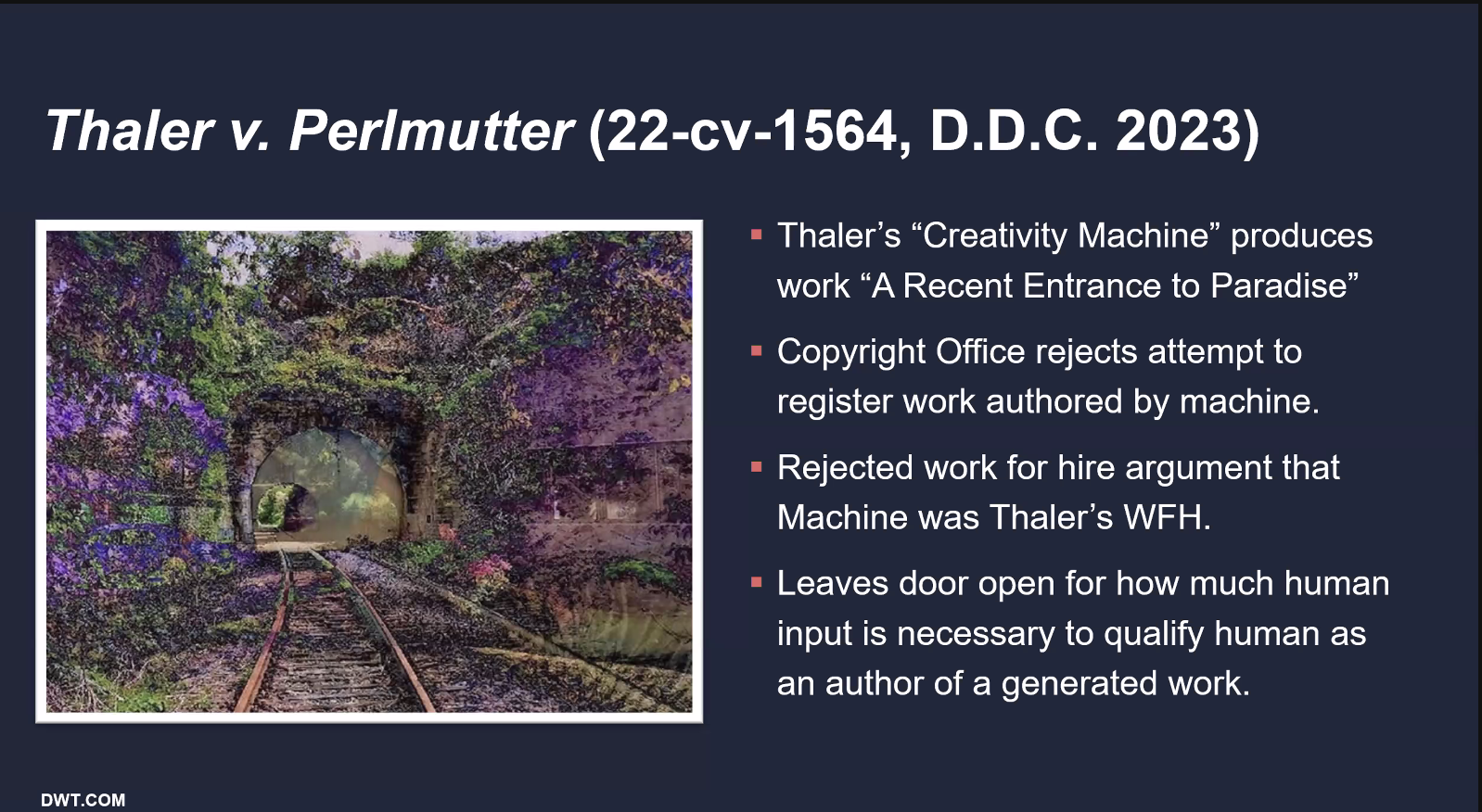
In March 2026, the Supreme Court declined to hear Thaler v. Perlmutter.
This leaves in place the D.C. Circuit’s March 2025 ruling.
There was no ruling on the merits. This doesn’t set precedent.
Stephen Thaler listed his AI system as the sole author, disclaimed any human creative contribution, and asked for copyright protection anyway. The DC court said no.
The D.C. Circuit held that copyright law requires a human author, which did not disqualify using AI assistance.
Questions not resolved:
1. How much Human involvement is enough?
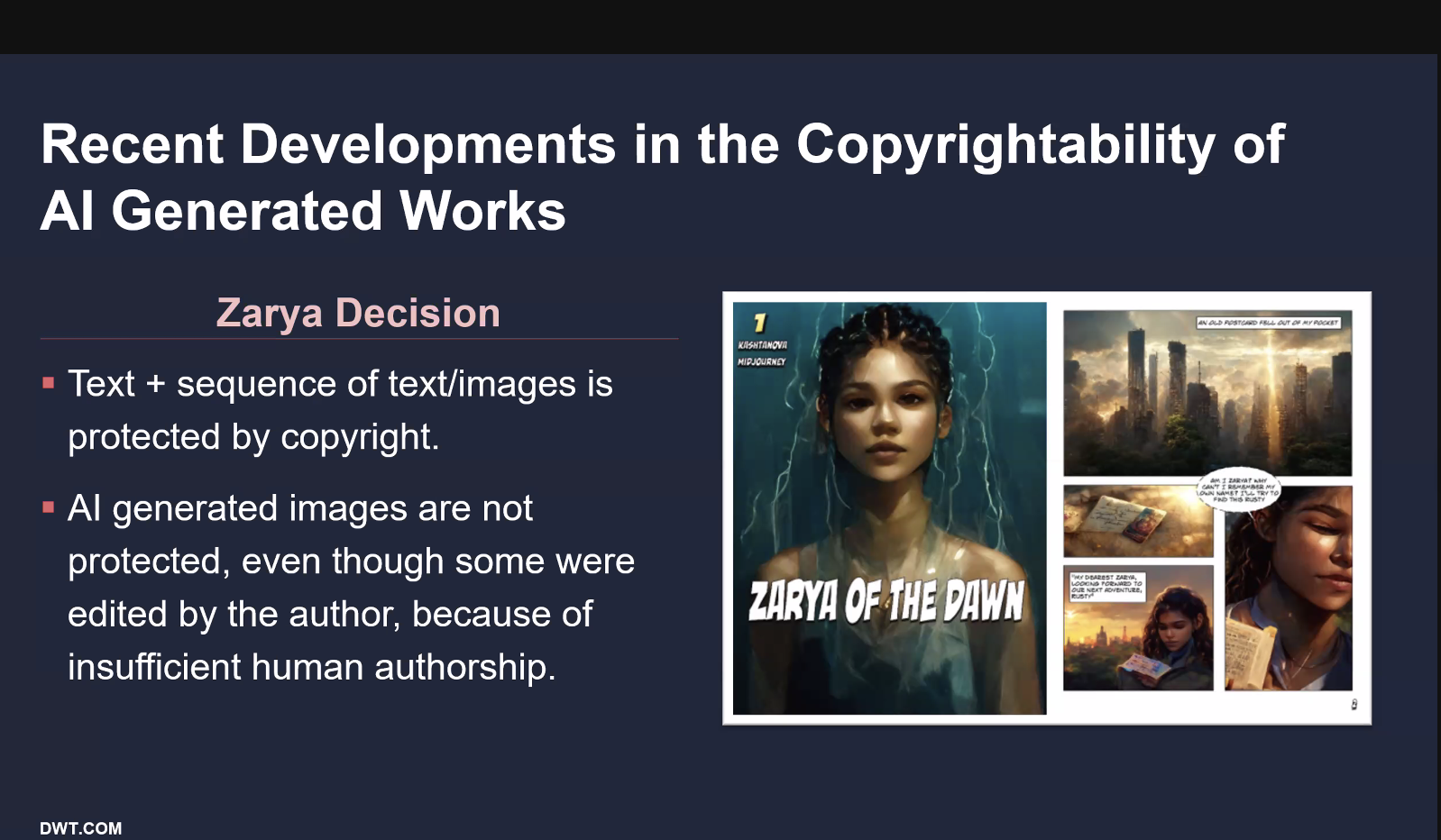
The US Copyright Office said in its “Zarya of the Dawn” comic book registration decision that the AI- images weren’t protectable, but the human-authored text and the selection and arrangement of text and images were. So far, the Office has said that prompts are not copyrightable—prompting is more like giving instructions to a commissioned artist than actually determining the expressive content of the final image. But what if dozens, even hundreds of prompts are entered? Wouldn’t that involve substantial human effort, iterative refinement, and a creative vision? The Copyright Office says getting different results from the same prompt is proof the user isn’t controlling the expression. The underlying question is this: Is prompting closer to authorship or closer to curation?
2. Can you prove what you Contributed?
If your work incorporates more than a de minimis amount of AI-generated material, the Copyright Office requires a disclosure statement about the AI involvement and a description of your human contribution. This means the creator must keep files, prompts, drafts, notes on what was intended and layered edits—in case there is a need to prove exactly what the human contribution was. A copyright applicant can avoid this simply by not disclosing the AI use. The system, in effect, rewards silence.
3. What Happens When Uncopyrightable AI Output Gets Licensed Anyway?
AI-generated materials are already being licensed, bundled, and sold. An example: Someone took a Python library and used an AI coding agent to rewrite it, then changed the project’s license to a more permissive one. The original creator objected, saying the original license still applied.
4. AI Output Can Absolutely Infringe. So Now What?
The SCOTUS denial also prompted a wave of commentary suggesting that AI-generated works now exist in some kind of copyright-free zone. They don’t. Issues still on the table: Whether AI-generated summaries of news articles are substitutive enough to infringe, and whether AI-generated narrative retellings of novels cross the line from ideas to expression. One judge dismissed claims that AI bullet-point summaries of investigative journalism were substantially similar to the originals. The same judge allowed a lawsuit to proceed because ChatGPT’s summary of a novel was might have captured the “overall tone and feel” of the original work.
Bottom line: Millions of people are using AI tools every day without knowing whether what they’re making is protectable, infringing, both, or neither.
Thaler Is Dead. Now for the AI Copyright Questions That Actually Matter
One loves that for which one labors, and one labors for that which one loves. – Erich Fromm
You won't see the code yourself anymore, the robots will write it for you. Half the time, the code they write will be garbage, or nonsense. Slop. But it's so cheap to write that the computer can just throw it away and write some more, over and over, until it finally happens to work. Is it elegant? Who cares? It's cheap. Ten thousand times cheaper than paying you to write it, so we can afford to waste a lot of code along the way. If you were one of those crafters—the people who wrote idiomatic code that made that programming language sing—there's a real grief here. It's not as serious as when we know a human language is dying out, but it's not entirely dissimilar, either. -Anil Dash
Research integrity is locked into an arms race with agentic AI slop – LSE
AI can help with research, but humans must remain accountable say university executives – Times Higher Ed
Hallucinated citations produced by generative artificial intelligence may constitute research misconduct when citations function as data in scholarly papers – Taylor & Francis
AI tool flags plagiarism in 95% of Ph.D. theses submitted this year at India university. – Times of India
How AI use in scholarly publishing threatens research integrity, lessens trust, and invites misinformation – Bulletin of the Atomic Scientists
Hallucinated References: Five Excuses for Academic Misconduct – Dorethea Baur
Ministers urged not to allow data mining of academic literature – Research Professional News
Librarian finds ‘preposterous number’ of fake references in paper from Springer Nature journal – Retraction Watch
AI is inventing academic articles – and scholars are citing them – the Observer
DataSeer develops AI system to track dataset reuse – Research Information
Journal Submissions Riddled With AI-Created Fake Citations – Inside Higher Ed
Account for AI in the environmental footprint of scientific publishing – Nature
Will AI Help or Hinder Scientific Publishing? – Undark
Hey ChatGPT, write me a fictional paper: these LLMs are willing to commit academic fraud. – Nature
Scientists are failing to disclose their use of AI despite journal mandates, finds study – Physics World
AI in the editorial workflow: Journals set the rules, institutions set the habits – Scholarly Futures
AI is turning research into a scientific monoculture - Nature
What happens when reviewers receive AI feedback in their reviews? – ArXiv
Fear of stigma blamed as 0.1 per cent of papers declare AI use - Times Higher Ed
Transhumanism - A philosophical movement that advocates attempting to unlock human potential through artificial intelligence and science, with the goal of overcoming biological limitations and combating aging and illness to achieve immortality. This might be achieved through humans merging with machines or upload human consciousness into digital realms. In effect, transhumanism seeks to redefine what it means to be human. In 1957, Julian Huxley summarized the term as “man remaining man, but transcending himself, by realizing new possibilities of and for his human nature.” Critics warn that this effort could erode the very qualities that define humanity, such as empathy, vulnerability and shared experience while exacerbating social inequalities.
Our sleep habits both reveal and shape our loves. A decent indicator of what we love is that for which we willingly give up sleep.
My willingness to sacrifice sleep reveals less noble loves. I stay up late later than I should, drowsy, collapsed, on the couch, vaguely surfing the internet, watching cute puppy videos. Or I stay up trying to squeeze more activity into the day to pack it with as much productivity as possible. My disordered sleep reveals a disordered love, idols of entertainment or productivity.
My willingness to sacrifice much-needed rest and my prioritizing amusement or work over the basic needs of my body and the people around me reveal of that these good things—entertainment and work—have taken a place of ascendancy in my life.
Tish Warren, Liturgy of the Ordinary
No sooner do we believe that God loves us than there an impulse to believe that he does so, not because he is love, but because we are intrinsically lovable. But then, how magnificently we have repented (so) we next offer our own humility to God’s admiration. Surely, he’ll like that. If not that, our clear-sighted and humble recognition that we still lack humility. Thus, depth beneath depth and subtlety within subtlety, there remains some lingering idea of our own, our very own, attractiveness.
It is easy to acknowledge but almost impossible to realize for long, that we are mirrors whose brightness if we are bright, is wholly derived from the sun that shines upon us. Surely we must have a little – however little – native luminosity?
We want to be loved for our cleverness, beauty, generosity, fairness usefulness. The first hint that anyone is offering us the highest love of all is a terrible shock.
CS Lewis, The Four Loves
AI literacy does not require waiting for a formal training program. A useful starting point is developing what researchers describe as output skepticism — the habit of asking, for any AI-generated result, whether the system could plausibly have reached that conclusion incorrectly and, if so, what the downstream consequences would be. Effective AI literacy is not about mastering the tool — it is about knowing where the tool ends and your own judgment begins. -JD Supra
“The capacity of AI is so endless that it can be really hard to just say no and stop whatever the next improvement is that you want. As a perfectionist, that often can result in not knowing when to stop. The next best thing is possible, so, often, you end up spending more time writing the perfect workflow and telling AI what to do." - Jack Downey, Head of Strategy, Operations and Product at Webster Pass Consulting, quoted by CBS News
Model Context Protocol (MCP) - This server-based open standard operates across platforms to facilitate communication between LLMs and tools like AI agents and apps. Developed by Anthropic and embraced by OpenAI, Google and Microsoft, MCP can make a developer's life easier by simplifying integration and maintenance of compliant data sources and tools, allowing them to focus on higher-level applications. In effect, MCP is an evolution of RAG. This allows an AI model to talk to Excel or PowerPoint, executing tasks autonomously.
Man is not what he thinks he is, he is what he hides. -André Malraux
Humans — not AI — are to blame for deadly Iran school strike, sources say. According to former military officials and people familiar with aspects of the bombing campaign in Iran, the thousands of people who gather intelligence and analyze satellite photos to build massive target lists ahead of potential conflicts with foreign adversaries are to blame for the deadly Iran school strike. The error was one that AI would not be likely to make: US officials failed to recognize subtle changes in satellite imagery, while human intelligence analysts missed publicly available information about a school located inside the Revolutionary Guard compound. -Semafor
Make things and you will discover yourself. The act of creation reveals who you are.
Notes on RISJ’s AI and the Future of News symposium - Harvard’s Nieman Lab
How Journalists Can Make AI Work for Them - Columbia Journalism ReviewNotes on RISJ’s AI and the Future of News symposium
A lot of journalism folks are offering editing advice as Grammarly’s AI “experts” – Harvard’s Nieman Lab
Ars Technica Fires Reporter After AI Controversy Involving Fabricated Quotes – Futurism
Can AI Save Local News? – Wall Street Journal
As AI data centers scale, investigating their impact becomes its own beat – Harvard’s Nieman Lab
Ars Technica Fires Reporter After AI Controversy Involving Fabricated Quotes - Futurism
In This Cleveland Newsroom, AI Is Writing (But Not Reporting) the News – Columbia Journalism Review
Retraction of article containing fabricated quotations by an AI Tool - Arstechnica
Eight in ten of world’s biggest news websites now block AI training bots – Press Gazette
The Fight over AI at McClatchy - Columbia Journalism Review
New York Times publisher: AI is using our facts without paying for them – Mediaite
Generative Engine Optimization FAQs from the ‘What Is AI Reading?’ report - Muck Rack
College paper fights to stop AI slop website from stealing its identity – Washington Post
How AI is reshaping the news industry - Harvard’s Nieman Lab
How will AI reshape the news in 2026? Forecasts by 17 experts from around the world – Reuter Institute
How AI is affecting me as a human (and journalist) – Axios
Here are the news outlets that got AI right in 2025 — and the ones that got it very, very wrong – Poynter
AI Used to Promote Non-Existent Evacuation Flights From the Middle East – Bellingcat
What the ‘AI inflection point’ means for journalism – Fast Company
The things you record with your AI-powered Meta Ray-Ban glasses — yes, even those intimate moments where you think you're alone — are probably being seen by strangers. An investigation by two Swedish newspapers found that offshore Meta workers in Kenya were asked to analyze intimate and even "disturbing" videos taken by glasses wearers, including videos taken in bathrooms, footage featuring nudity and sexual content, and images showing personal information like bank accounts. It's part of a process known as data labeling, used to train AI models with footage first reviewed and annotated by humans so that the AI can understand what it's "looking" at. -Mashable
Becoming is a service of Goforth Solutions, LLC / Copyright ©2026 All Rights Reserved