Illusions
/Our illusions can ravage us as mercilessly as violence or disease. And the illusions of others, when
they take on lives of their own, are even more dangerous. -Nicholas Christopher

Ideas that challenge / comfort / inspire
Stephen Goforth
Our illusions can ravage us as mercilessly as violence or disease. And the illusions of others, when
they take on lives of their own, are even more dangerous. -Nicholas Christopher
AI Economics for Dummies - McSweeneys
Nvidia says AI's water challenge is largely solved - Axios
The Cloud Has Sound: The Unrelenting and Unseen Cost of A.I. Data Centers – New York Times
1.5M people use GenAI.mil, the Defense Department’s enterprise generative AI platform – Defense Scoop
Google director resigns, citing its military deals: 'Management has lost its moral compass' – Business Insider
The White House said Anthropic’s powerful AI was ‘jailbroken.’ Here’s what that means. – Washington Post
All the Money Flooding Into AI Is a Giant Warning Sign – Wall Street Journal
Anthropic is pulling its two newest AI models after a U.S. government directive – Quartz
Wall Street is raining unprecedented cash on the hyperscalers - Axios
OpenAI plots biggest ChatGPT overhaul since launch – Financial Times
Revenge of the AI bubble - Axios
The world’s mathematicians just issued a formal declaration telling AI companies to stop using their work without permission – The Next Web
Meta’s AI agent for WhatsApp Business is now available globally – Tech Crunch
Microsoft Wants to 'Make People Addicted' to its New AI Assistant, Internal Documents Reveal - 404 Media
Scientists Find Way to Supercharge Dangerous Computer ‘Worms’ With A.I. - The New York Times
OpenAI Sued by Florida’s Attorney General Over AI Harms - Wall Street Journal
Microsoft’s AI chief on the greatest game of catchup ever played – Semafor
Meta is reportedly working on an AI pendant and more smart glasses – Engadget
Anthropic Files to Go Public, Setting Stage for Huge I.P.O. - The New York Times
Imagine I tell you that a group of 30 engineers and 70 lawyers have applied for a job. I show you a single application that reveals a person who is great at math and bad with people, a person who loves Star Wars and hates public speaking, and then I ask whether it is more likely that this person is an engineer or a lawyer. What is your initial, gut reaction? What seems like the right answer?
Statistically speaking, it is more likely the applicant is a lawyer. But if you are like most people in their research, you ignored the odds when checking your gut. You tossed the numbers out the window. So what if there is a 70 percent chance this person is a lawyer? That doesn’t feel like the right answer.
That’s what a heuristic is, a simple rule that in the currency of mental processes trades accuracy for speed. A heuristic can lead to a bias, and your biases, though often correct and harmless, can be dangerous when in error, resulting in a wide variety of bad outcomes from foggy morning car crashes to unconscious prejudices in job interviews.
David McRaney writing in BoingBoing
Knowledge distillation (KD) - A machine learning technique that transfers the learnings of a large pretrained model to a smaller model. While the “student model” will mimic the predictions of the big one, it is more agile and efficient, able to make better real-time decisions than a large model. The smaller model can also more easily include in its structure “explainability” (reasoning behind the decisions). KD is often used in deep learning and particularly for deep neural networks.
NewsGuard is launching “the first AI chatbot built to deliver trusted journalism only from reliable news websites” drawing from 12,000 vetted publishers. NewsGuard will share revenues 50-50 with cited news publishers. -Editor & Publisher
Can AI Predict Satellite Failures Before They Happen? The US Air Force Wants to Find Out – Military.AI
The US Military Has Been Using Elon Musk’s Grok AI to Bomb Iran – Futurism
Pentagon boasts of using AI to write reports mandated by Congress – Ars Technica
AI Warfare Is at the Point of No Return. What Now? – Wall Street Journal
White House Approves $9 Billion for Spy Agencies to Catch Up on A.I. – New York Times
Air Force Buys New Generation of Drones Made to Strike Deep Into Enemy Territory – Wall Street Journal
Germany is launching military AI into space – Reuters
AI models are being used to predict conflict – Economist
1.5M people use GenAI.mil, the Defense Department’s enterprise generative AI platform - Defense Scoop
The Killer Robots Are Coming. The Battlefield Will Never Look the Same. – New York Times
Google director resigns, citing its military deals: 'Management has lost its moral compass' – Business Insider
Mutually Automated Destruction: The Escalating Global A.I. Arms Race – New York Times
The real danger of military AI isn’t killer robots; it’s worse human judgement – Defense One
Humans — not AI — are to blame for deadly Iran school strike, sources say – Semafor
Cascade of A.I. Fakes About War With Iran Causes Chaos Online – New York Times
Cheap drones transform global battlefield – Axios
Pentagon leverages AI in Iran strikes amid feud with Anthropic - The Washington Post
Lockheed test-flies F-35 with artificial intelligence to quickly ID unknown contacts – Breaking Defense
AIs can’t stop recommending nuclear strikes in war game simulations – New Scientist
Whistleblower says Israeli military contractor used Google's Gemini AI - The Washington Post
10 well-being questions to ask in your next job interview - AMA
38 Smart Questions to Ask in a Job Interview - Harvard Business Review
41 impressive questions to ask in a job interview - ZDnet
8 Questions To Ask An Interviewer - GlassDoor
Avoid these 9 mistakes when answering interview questions - Fast Company
Four questions you will likely get asked at a media job interview and how to avoid killing your chances with your answers - Dynamics of Writing
How to Answer Anecdotal Interview Questions - LifeHacker
How to Answer ‘Tell Me About Yourself’ - Undercover Recruiter
How to Succeed in a Virtual Interview - Indeed
Interview Questions to Ask Your Interviewer - Dave Ceddia
How ChatGPT can help people prepare for job interviews — and users say it works - Business Insider
How to Impress on Your Job Interview - UCF
How to Succeed in Your Next Job Interview - Harvard Business Review (video)
Interviewing for your next job? Avoid this common mistake - CNBC
There's a Right Answer to What's Your Greatest Weakness in a Job Interview - Inc
The Trick to Bragging in a Job Interview - Wall Street Journal
Recent empirical research suggests that AI search systems exhibit a measurable bias toward earned media. LLMs disproportionately retrieves information from journalistic sources, reputable trade publications and government data over brand content that lacks third-party validation or structured, factual framing. -Muckrack
What: This session brings structure to the process of keeping up with AI, helping you identify where AI fits and where it does not. Discover how to focus your efforts, apply AI to real challenges, and build a strategy that supports consistent, mission-driven work.
Who: Loree Lipstein, Founder and CEO, Thread Strategies; Sara LaCava Lieberman, Principle, Thread Strategies.
When: 2 pm, Eastern
Where: Zoom
Cost: Free
Sponsor: Bloomerang
What: The Academic AI Impact Study, based on in-depth interviews with library professionals across eight institutions, provides evidence on how AI is reshaping core library workflows. Join practitioners from the study as they share what changed in their day-to-day operations, why human oversight remains essential, and what library leaders should consider as they evaluate AI adoption in their own institutions.
Who: Melissa Gomis, Associate Professor of Practice, Chair, Collections Strategy & Open Scholarship, University Libraries at University of Nebraska-Lincoln; Adil Husain, Founder, The Intelligence Council and Managing Director, Emerging Strategy; Amit Niv, Head of Metadata and Process Management, Younes & Soraya Nazarian Library.
When: 11 am, Eastern
Where: Zoom
Cost: Free
Sponsor: Library Journal
What: This session will help you understand where the tools stand today and how best to implement them into your presentation work. Research, structure, design, visuals, and rehearsal -- there are AI tools for all of these facets! Along the way, we’ll also look at where human judgment still matters most.
Who: Rick Altman Director, BetterPresenting.com.
When: 12 pm, Eastern
Where: Zoom
Cost: Free
Sponsor: Training Magazine Network
What: This webinar will provide attendees with practical knowledge on collaborative election monitoring, AI-assisted verification workflows, and newsroom coordination strategies.
Who: Nelly Kalu, multi-format broadcast and investigative journalist and Product and Innovation Manager at the Center for Collaborative Investigative Journalism.
When: 12 pm, Eastern
Where: Eventbrite
Cost: Free
Sponsor: Center for Cooperative Media
What: We'll cover the basics of data centers and finding information and sources for data center investigations.
Who: Erika Owens, Pulitzer Center; Laís Martins AI Fellow; Pablo Jiménez Arandia AI Fellow.
When: 12:30 pm, Eastern
Where: Zoom
Cost: Free
Sponsor: Pulitzer Center
What: Our panel will discuss what it takes to be successful when stepping out on your own. You’ll receive practical tips from seasoned freelancers on how to court clients, craft pitches and carry out the business aspects of operating as an independent journalist. Whether you’ve been freelancing for years or you’re new to independent writing, this session is for you.
Who: Mallika Mitra, business and financial freelance journalist; Chris Morris, contributing writer at Fast Company, Inc., Moneywise and AARP; Chris Taylor, personal finance journalist; Ellen Sheng, founder and principal, Sheng Media.
When: 1 pm, Eastern
Where: Zoom
Cost: Free
Sponsor: Society for Advancing Business Editing & Writing
What: The future of fundraising is not about reaching more people, but reaching the right people. This session explores how AI enables a more focused approach, prioritizing quality over quantity. Learn how nonprofits are reducing unnecessary contact while improving revenue and strengthening trust with their communities.
Who: Tim Paris, Co-founder and CEO, Dataro.
When: 2 pm, Eastern
Where: Zoom
Cost: Free
Sponsor: Bloomerang
What: Codex can help marketing teams turn scattered context into useful deliverables your team can review, refine, and share. Join us for a practical session on where Codex can fit into marketing workflows. We’ll focus on bringing context together, shaping useful outputs, and reviewing quality before anything gets shared.
Who: Diana Stegall, Customer Education, OpenAI; Lois Newman, Customer Enablement, OpenAI; Charmaine Pek, AI Deployment, OpenAI; Jen Beltran ,AI Deployment Manager, OpenAI.
When: 2 pm, Eastern
Where: Zoom
Cost: Free
Sponsor: OpenAI Academy
Who: Marlene Harris-Taylor, American Press Institute
When: 4 pm, Eastern
Where: Zoom
Cost: Free
Sponsor: Center for Scholastic Journalism at Kent State University & and Trusting News
What: This interactive focus group will discuss the realities of AI for small businesses. We want to hear about your successes, your frustrations, and your hesitations. Your real-world feedback will directly influence future state economic initiatives and help us design the exact training, workshops, and resources small businesses need to navigate the evolving tech landscape.
Who: Brett Smith, Director, Lehigh University SBDC.
When: 11 am, Eastern
Where: Zoom
Cost: Free
Sponsor: Lehigh University Small Business Development Center
What: Strategies and practical tips for working with officials to lower the fees for open records.
Who: Kimbriell Kelly, editor-in-chief of Chicago Public Media and VP for the Fund for Investigative Journalism.
When: 12 pm, Eastern
Where: Zoom
Cost: Free
Sponsor: The Fund for Investigative Journalism
What: Become AI-literate in the concepts most immediately to impact your career so you can start the process of upskilling now and thrive in your career for years to come.
Who: Heather Mansfield, Founder of Nonprofit Tech for Good.
When: 1 pm, Eastern
Where: Zoom
Cost: Free
Sponsor: Nonprofit Tech for Good
What: Meena Das Founder, Namaste Data and the AI Equity Project
Who: Discover how to assess AI decisions through a values-driven lens and build practices that strengthen trust and guide smarter choices.
When: 2 pm, Eastern
Where: Zoom
Cost: Free
Sponsor: Bloomerang
What: We will examine why most AI initiatives stall after early adoption and what organizations must change internally to turn AI investment into real operational performance. We will share a clear framework for aligning AI initiatives with workforce readiness, role-based capability development and scalable execution. Attendees will leave with a stronger understanding of why AI strategies fail and what leading organizations are doing differently to close the gap between adoption and impact.
Who: LearnQuest managing director, Dimitri Schneiberg.
When: 1 pm, Eastern
Where: Zoom
Cost: Free
Sponsor: Training Industry
What: We will explore how a new generation of agentic AI is reshaping what’s possible for philanthropic organizations. Drawing on real‑world experience across analytics, fundraising strategy, and emerging AI capabilities, this session reframes personalization not as a manual effort, but as a scalable, outcome‑driven approach.
Who: Blackbaud experts Stephen Churchill and Carol Belair.
When: 1 pm, Eastern
Where: Zoom
Cost: Free
Sponsor: Blackbaud
What: We will discuss the legal obstacles journalists encounter when they try to obtain public records, how the attorneys of the Reporters Committee work with them to overcome those challenges, and how this affects your First Amendment Freedoms.
Who: Marisa Kabas, Independent Writer and Reporter; Adam Marshall, Director of National Litigation·Reporters Committee for Freedom of the Press.
When: 2 pm, Eastern
Where: Zoom
Cost: Free
Sponsor: Reporters Committee for Freedom of the Press
What: Marketing your newsroom’s work is essential to securing support, building audiences, and advancing your mission. We will help participants strengthen their elevator pitch, identify barriers to self-promotion, and find the words that clearly communicate the uniqueness and fundability of their work.
Who: Ken Schneck, Editor of The Buckeye Flame.
When: 3 pm, Eastern
Where: Zoom
Cost: Free
Sponsor: New England Newspaper & Press Association
What: This session will describe how Generative AI has been used in the mathematics teacher education in Singapore, and a glimpse into the use of Gen AI in school mathematics classroom. More importantly, he will also present an alternative paradigm of using Gen AI embedding into the problem-solving mathematics curriculum.
Who: Tin Lam TOH, Associate Professor, National Institute of Education, Nanyang Technological University, Singapore.
When: 8 pm, Eastern
Where: Zoom
Cost: Free
Sponsor: The National Academy of Sciences
What: In this session, we'll talk about the different ways Google is presenting content, and how you can make sure your pages get found. We'll cover keyword research, linking best practices, and coverage tips to help you stand out from the competition.
Who: Tyson Bird is the Editorial Product Manager at American City Business Journals.
When: 2 pm, Eastern
Where: Zoom
Cost: $35
Sponsor: Online Media Campus
What: An exploration of the key findings from the 2026 edition of the Reuters Institute’s Digital News Report and the implications for publishers.
Who: Jim Egan, Senior Research Associate, Reuters Institute; Kevin Anderson, Director, Digital Revenue Network, WAN-IFRA London.
When: 8 am, Eastern
Where: Zoom
Cost: Free to World Association of News Publishers members
Sponsor: World Association of News Publishers
The reason most people never reach their goals is that they don't define them, learn about them, or even seriously consider them as believable or achievable. – Denis Waitley
My father didn't tell me how to live; he lived, and let me watch him do it. -Clarence Buddinton Kelland
Probably the best thing to do with your last words is to say goodbye to the people you love and not to talk about yourself. -Martha Nussbaum
What are your values, goals, weaknesses?
What don't you like to do?
What work environment do you NOT like?
What's your passion for life and career?
Describe yourself.
Take deep breaths.
Remember, they want to find the right person; They want you to do well.
Listen, eye contact, sit up straight, enthusiasm, confidence (sound authoritative).
1. Behavior-specific skills (ex: “Tell me about a time where…”).
2. Case-specific problems (ex: “Here is a business case for you to work through.”).
3. Stress (more than one interviewer firing questions, i.e., let's see how you do under stress).
Where do you see the company in the next 5 years?
How would you describe the atmosphere here? (formal or informal, etc)
How does the company support work-life balance?
Are things handled differently for in-office and hybrid workers?
How does the company determine salary levels?
What was the reason last person left? How long was she in that position?
Why is this position available?
How far along in the interview process am I?
Have there been any changes in the company I should know about—such as layoffs or changes in leadership?
What did you like about the last person in this position?
How many times has it turned over in the last 5 years? (if a lot, ask why)
Who do I report to? Who would work under me?
What are my responsibilities?
Describe a typical day.
Do you have a written job description (get a copy)
What is the potential for promotion?
What is the greatest challenge I will face?
What problems might I face in the job?
How would you describe your management style?
How soon do you hope to make a decision?
Can I take a tour of the facilities?
Do you have any hesitancy in hiring me?
Health benefits booklet?
holidays and vacations?
Do you have any “employee resource groups” (eg.)?
"Thank you for meeting with me."
Towards autonomous medical artificial intelligence agents – Nature
AI helped diagnose 18 children whose rare diseases had stumped doctors – NBC News
AI Is Taking Over Hospitals – The Atlantic
How AI is helping fight the latest Ebola outbreak - Semafor
Doctors Inject Human Subjects With First Vaccine Designed by AI – Futurism
AI Model Links Tumor Mutations to Treatment Response - UCSD
HHS Launches Crackdown Using AI to Detect Medicaid Fraud and Waste – Wall Street Journal
Wearables increasingly look to AI to predict health problems before they happen – Seattle Times
The Hantavirus Outbreak Is Resurrecting Covid-Era Misinformation Tactics – New York Times
How AI is making health care even less affordable – Axios
AI outperforms doctors in Harvard trial of emergency triage diagnoses – The Guardian
Your Doctor Is Using A.I. to Take Notes. What Could Go Wrong? – New York Times
Thinking of using a chatbot for medical advice? Read this first. – Washington Post
Therapists are using AI to take notes. Is it a useful tool or a breach of trust? – NPR
Artificial intelligence is being used in South Korea to make care calls to older adults who live alone and to fight dementia – New York Times
AI scamming ain’t brain surgery, but even neurosurgeons get fooled - The Hill
Doctors' growing AI deepfakes problem – Axios
How Stanford patients help expose ‘fault lines’ in health AI adoption – Stat
Have a Thorny Medical Question? Your Doctor May Be Using A.I. for That. - New York Times
The only people who see the whole picture are the ones who step outside the frame. -Salman Rushdie (born June 19, 1947)
In some cases, the very same companies selling AI detection tools are also making apps that allow students to cheat, including by writing papers for them or rephrasing text written by others. The head of education at the A.I. company that makes Grammarly calls the race between detection and evasion “ultimately, a dead end.” She urges educators to accept that most future writing would be produced in a partnership between artificial intelligence and human discernment. -New York Times
Natural Language Processing - This type of machine learning transfers language into numbers to make it intelligible to machines. The first step is tokenization, where text is divided into word units called tokens. These tokens are then transformed into vectors (lists of numbers). A single word token might be represented by more than 1,000 numbers in a vector. The vector is considered to have a higher dimension when many numbers are used. The meaning is therefore nuanced. A low dimension for a vector means the list of numbers is low. While a low dimension is not as nuanced, it is easier to work with. A deep learning model (typically a transformer model) can use these vectors to understand the meaning of words and determine how the words relate to one another. An example would be “king “relates to “man” while “queen” relates to “woman.”
When researchers presented a large language model with 72 simulated regulatory environments, the AI learned to exploit loopholes in everything from credit card rewards programs to school funding formulas, despite never being instructed to do so. The loopholes couldn’t be patched fast enough to keep up with the mischief. In more than 100 iterations of five scenarios, the model kept finding new exploits, each more subtle than the last. And existing safety mechanisms didn’t catch the rule-bending behavior. -Science.org
Elizabeth Stokoe, professor of social interaction at Loughborough University, and her colleagues, have analysed thousands of hours of recorded conversations, from customer services to mediation hotlines and police crisis negotiation. They discovered that certain words or phrases have the power to change the course of a conversation.
People who had already responded negatively when asked if they would like to attend mediation seemed to change their minds when the mediator used the phrase, “Would you be willing to come for a meeting?” “As soon as the word ‘willing’ was uttered, people would say: ‘Oh, yes, definitely’ – they would actually interrupt the sentence to agree.” Stokoe found it had the same effect in different settings: with business-to-business cold callers; with doctors trying to persuade people to go to a weight-loss class. She also looked at phrases such as “Would you like to” and “Would you be interested in”. “Sometimes they worked, but ‘willing’ was the one that got people to agree more rapidly and with more enthusiasm.”
Rosie Ifould writing in The Guardian
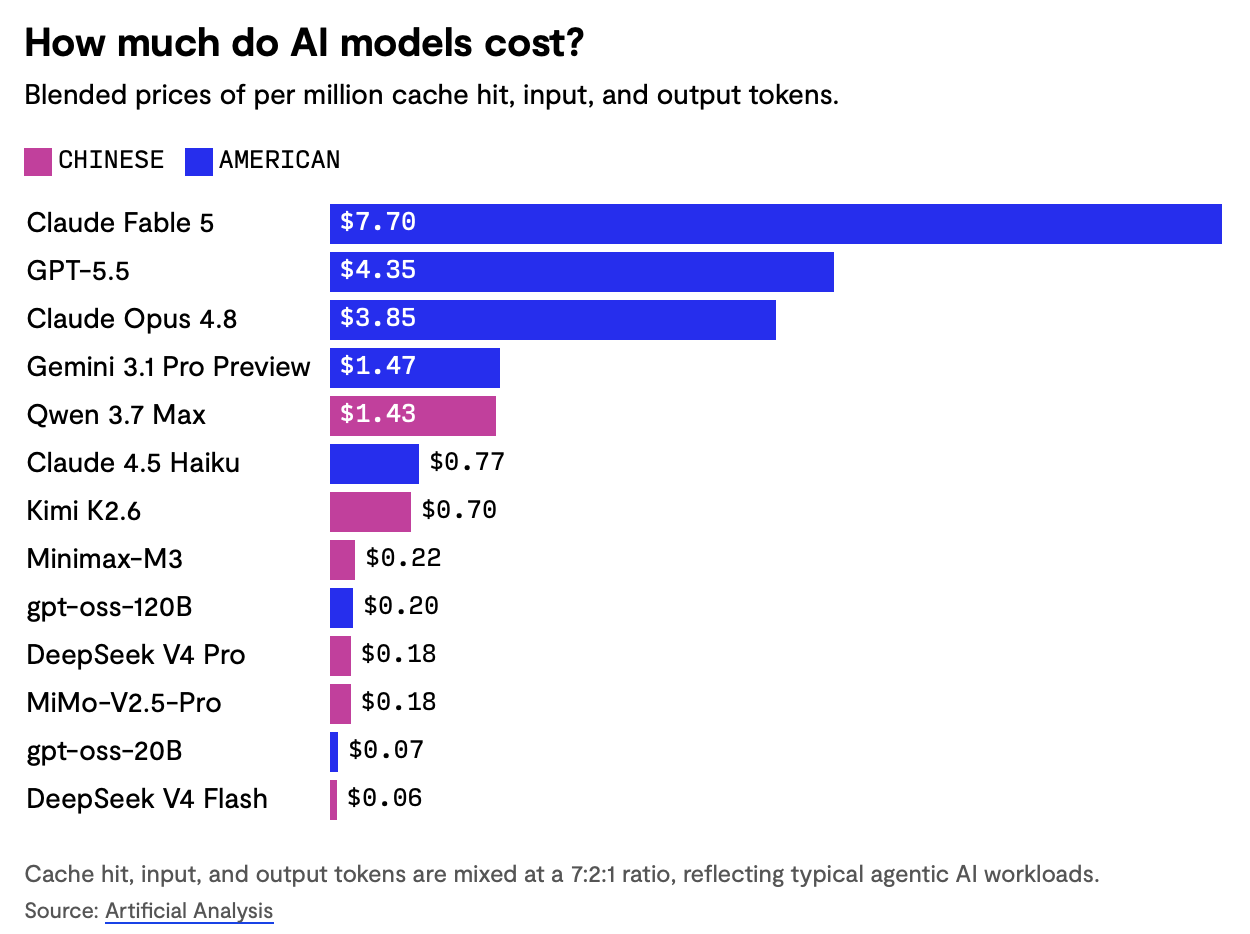
U.S.-based developers and small companies are turning to Chinese models to cut costs. Although Chinese models still lag behind the best American ones in performance, they can handle most tasks at a fraction of the price. -Rest of World
Becoming is a service of Goforth Solutions, LLC / Copyright ©2026 All Rights Reserved