Charting the Course
/Anyone can steer the ship, but it takes a leader to chart the course. -John Maxwell

Ideas that challenge / comfort / inspire
Stephen Goforth
Anyone can steer the ship, but it takes a leader to chart the course. -John Maxwell
4 Skills PR newbies should possess
7 Things you never say in a PR agency job interview
10 Things every PR portfolio must have
10 Unconventional ways to find a PR job
From the pros: job-seeking advice everyone should know
How to choose between agency and in-house roles
How to write a great bio: A strong “about me” can really make you stand out
Interns should do more than work on social media
Using Social Media (and other tools) to find a PR job
What job seekers should—and should not—share on social media
If your goal is simply to mitigate the harmful impact loneliness can have on your health, what matters most is having at least one important person in your life — whether that’s a partner, a parent, a friend or someone else, said Jeffrey Hall, a professor of communication studies at the University of Kansas.
The best-known theory of how many friends people can (though not necessarily should) have comes from British psychologist and anthropologist Robin Dunbar. What has come to be known as Dunbar’s number contends that humans are only cognitively able to maintain about 150 connections at once (subsequent research has put the number higher). That includes an inner circle of about five close friends, followed by larger concentric circles of more casual types of friends.
The amount of time you actually spend with your friends matters, too. Dr. Hall’s research suggests that on average, very close friendships tend to take around 200 hours to develop. Quantity and quality go hand-in-hand.
Catherine Pearson writing in the New York Times
The art of love ... is largely the art of persistence. -Albert Ellis
Football players from Rome High School jumped into action to rescue a woman trapped inside her car after a crash in front of their school. The video below has the story or read the story here.
Argue for your limitations long enough, and, sure enough, they’re yours. -Richard Bach
For many of us, the main concern over decision-making is practical — how can we make better decisions? Neuroscientist Paul Glimcher said that his research has helped him develop specific strategies. “Rather than pick what I hope is the best, instead I now always start by eliminating the worst element from a choice set,” he said, reducing the number of options to something manageable, like three. “I find that this really works, and it derives from our study of the math. Sometimes you learn something simple from the most complex stuff, and it really can improve your decision-making.”
Emily Singer writing in Quanta Magazine
If you find yourself asking (and your friends), “Am I really a writer? Am I really an artist?” chances are you are. The counterfeit innovator is wildly self-confident. The real one is scared to death.
Steven Pressfield, The War of Art
The function of man is an activity in accordance with a certain arrangement or order in the soul (according to Aristotle). That is why Aristotle can conclude that the human good is an activity of soul in accordance with virtue: for virtue is a certain organization of the soul. How this order is instilled in man’s soul is a central issue of ethics. Of course, the exercise of the virtues will often involve man’s practical reason. But if the practical reasoning did not flow from a certain organization of the soul, it would be empty. In fact It is because a man’s life has a certain order that he is able to reason about it: the logos (or rational principle) in his mind will reflect the logos in his soul.
Jonathan Lear, Aristotle: The Desire to Know
Anybody can become angry—that is easy, but to be angry with the right person and to the right degree and at the right time and for the right purpose, and in the right way—that is not within everybody's power and is not easy -Aristotle
As we grow up, we realize it becomes less important to have more friends and more important to have real ones. Remember, life is kind of like a party. You invite a lot of people, some leave early, some stay all night, some laugh with you, some laugh at you, and some show up really late. But in the end, after the fun, there are a few who stay to help you clean up the mess. And most of the time, they aren’t even the ones who made the mess. These people are your real friends in life. They are the ones who matter most.
Have a courageous conversation with yourself. -John Maxwell
People who have high emotional intelligence understand that if you want to be more persuasive and even win most arguments, it's important to do two things:
· Avoid distracting, emotional mini controversies.
· Offer easy ways for people to overcome emotional objections, and more easily follow the path you want them to take.
I call this whole concept the "Emergency Exit Rule." It's about planting seeds that allow people to save face and maintain their pride--while ultimately agreeing with you.
Imagine a police detective arrests a suspect. During interrogation, he or she uses a common but controversial strategy called the Reid technique. It involves questioning frameworks that can be summarized by example, like this:
· "We know that you walked out of the store with the jewelry, but you don't seem like a bad person. Maybe you didn't realize how expensive it really was?"
· "It's clear you were intoxicated when the police pulled you over. Am I right in thinking you'd probably had only a couple of drinks, and didn't realize you might have been over the limit?"
The Emergency Exit Rule is all about giving them the easiest, most attractive way possible to back down and agree with your position.
Bill Murphy Jr. writing in Inc.
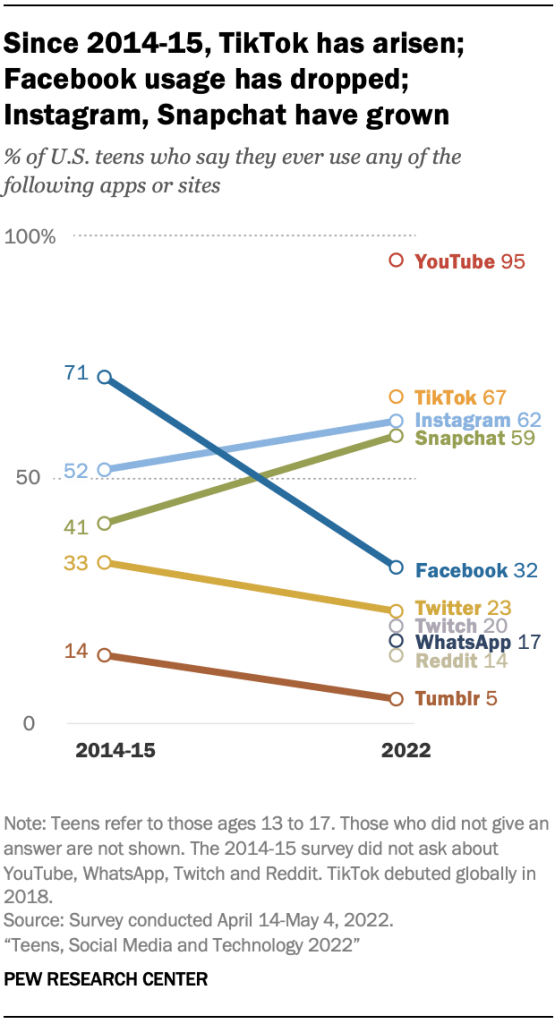
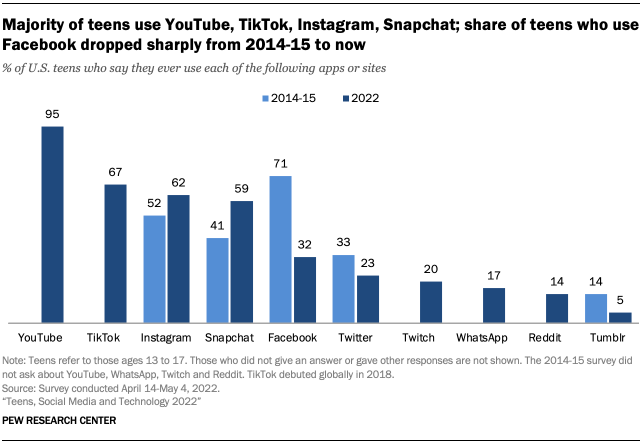
Teenagers are using TikTok (67%), Instagram (62%) and Snapchat (59%) more than other social media platforms to stay in touch with one another, according to the Pew Research Center. YouTube (95%) is their destination site for consuming media. Meanwhile, Facebook has lost most of its teen audience (from 71% in 2014 to 32%). The survey did not include chat and audio app Discord.
About a third of teens (36%) say they spend too much time on social media. Black teens were more likely to use TikTok while Hispanic teens were more likely than other groups to use WhatsApp. Read the details of the survey here and you’ll find a Washington Post article on the findings here.
Many smart people tell themselves lies like, “I do my best work at the last minute.” It’s not true. Writers sit at their desks for hours, wrestling with ideas. They ask questions, talk with other smart people over drinks or dinner, go on long walks. And then write a whole bunch more. Don’t worry that what you write is not very good and isn’t immediately usable. You get ideas when you write; you don’t just write down ideas.
Denise K. Magner writing in the Chronicle of Higher Ed
You can learn more from failure than success. (Here's why that's the case).
In failure you're forced to find out what part did not work. But in success you can believe everything you did was great, when in fact some parts my not have worked at all. Failure forces you to face reality.
Fred Brooks, author of The Mythical Man-Month
The dictatorship of data ensnares even the best of them. Google runs everything according to data. That strategy has led to much of its success. But it also trips up the company from time to time. Its cofounders, Larry Page and Sergey Brin, long insisted on knowing all job candidates’ SAT scores and their grade point averages when they graduated from college. In their thinking, the first number measured potential and the second measured achievement. Accomplished managers in their 40s were hounded for the scores, to their outright bafflement. The company even continued to demand the numbers long after its internal studies showed no correlation between the scores and job performance.
Google ought to know better, to resist being seduced by data’s false charms. The measure leaves little room for change in a person’s life. It counts book smarts at the expense of knowledge. And it may not reflect the qualifications of people from the humanities, where know-how may be less quantifiable than in science and engineering. Google’s obsession with such data for HR purposes is especially queer considering that the company’s founders are products of Montessori schools, which emphasize learning, not grades. By Google’s standards, neither Bill Gates nor Mark Zuckerberg nor Steve Jobs would have been hired, since they lack college degrees.
Kenneth Cukier and Viktor Mayer-Schönberger, writing in MIT’s Technology Review
16 simple things to do now to get a promotion this year - Fast Company
Considering professional development? Maybe prioritize this instead - Fast Company
Engineer A Winning Attitude At Work With These 7 Critical Soft Skills - Forbes
Everything you need to know about writing a resignation letter (samples included) - Fast Company
How to Prepare Your Finances Before Quitting Your Job - Wall Street Journal ($)
How Do You Know When It’s Time to Leave a Job? - Medium
How to avoid burnout without quitting your job - Women & Home
How to handle your work jerk - McKinsey
How to Quit your Job - Harvard Business Review
Planning to quit your job? 3 key things to think about first - ZDNet
Soft Skills Can Help you get ahead - Wall Street Journal ($)
'Soft skills': The intangible qualities companies crave - BBC
What These New Grads Wish They Knew before Starting Their First Jobs - Fast Company
David Brooks, in his book, The Road to Character (Random House), distinguishes between what he calls "résumé virtues" and "eulogy virtues." The former are the skills that get you good grades, good jobs, nice houses, and hefty bank accounts. The latter are what make you a good person. Though I think the distinction between skills and virtues is an important one, Brooks is wrong to imply that résumé virtues are all that we need to produce excellence at work, or that eulogy virtues are for what comes after one’s work has ceased. Eulogy virtues are just as important to becoming good doctors, good lawyers, good teachers, good nurses, good physical therapists, and even good bankers as are résumé virtues. And they are also important to becoming good children, parents, spouses, friends, and citizens. As Aristotle knew, virtue is needed for material success just as it is needed for moral success.
Always leave things better than you found them.
Becoming is a service of Goforth Solutions, LLC / Copyright ©2026 All Rights Reserved