Sharing photos may subtly change how we remember

When we’re hunting for the perfect Instagram shot, we’re not listening, we’re not smelling, we’re not always paying attention to the beautiful, complex minutiae that make up the moment.  

Powerful experiences in the real world are immersive and often engage all the senses. On your last vacation, can you remember what the wind felt like on your back? Do you remember what was going on internally: Were you thrilled, excited, or scared? When you look back on the Instagram photos from the trip, will you remember what a dinner tasted like, or just that it was pretty?  

Brian Resnick writing in Vox

Getting the Most out of Your Memories

The principle for having something be memorable is to attend to what’s distinctive about it. The more you can attend to what is distinctive and be mindful of it, the more vivid the memory.

We’re constantly taking pictures and then throwing them on social media. But this is the ultimate form of electronic amnesia. You’re cheating your experiencing self because you don’t connect with what’s happening, and you’re cheating your remembering self because you’ve deprived yourself of a great memory. 

So instead of taking pictures of every moment of your vacation, pay attention to what makes a particular moment distinctive. Ask yourself: What is going to be most memorable in each picture I take? How can I compose the picture to focus on the vivid details that will bring me back to this time and place?  That’s when pictures become valuable — when they force you to pay attention to the things that are important to you in that moment.

Neuroscientist Charan Ranganath quoted in Big Think

Social media is Evolving

As we hit the 20-year anniversary of Facebook, we’re finding that social media usage is changing in a fundamental way. The platforms are evolving:

 from displaying personal information publicly (“Here’s where I went on vacation”; “This is the food I ate at a fancy restaurant.”)

to a place to watch and listen to curated content (often resembling TV and streaming in short form)

Curated & Closed

Instead of status updates, there are algorithmically curated videos. Many of the users who were creating and posting are now just consuming—at least, in the public sphere. This is particularly pronounced among first-gen social media users, that is, millennials between the ages of 27 and 42. This is why Instagram has seem the most growth in the last five years in DMs and stories limited to friends. The type of content they used to share in public posting is moving into private messaging and closed groups.

The advantage of closed groups is:

  • Greater privacy

  • Less sensationalism

  • Improved mental health of users

The downside of closed groups includes:

  • The lack of moderation

  • The spread of misinformation

  • The spread of new ideas suffers

  •  The support of news outlets weakens   

Social media is becoming less social. There is less emphasis on connections and greater focus on individual consumption of media produced by content creators. This focus toward engagement amplifies extreme content, which (among other things) hinders the sharing of actual news content and accurate information.

 Read more:

The end of the social network – The Economist

People are posting a lot less on public social media – Fortune

First-Gen Social Media Users Have Nowhere to Go – Wired

Why the Internet isn’t Fun Anymore – The New Yorker

11 Newer Social Media Networks of Note

Artifact - discuss news stories.

BeReal - photo-sharing app.

Bluesky - a decentralized Twitter alternative (Android and invite only for now)

Discord - for playing video games with fellow gamers.

Gobo - switch between networks in the app, developed by the MIT Media Lab (May 2023).

Letterboxd - an app for film enthusiasts to share their opinions.

Mastodon - a Twitter clone sliced into communities.

Minus - users make only 100 posts on their timeline for life.

Nextdoor - for neighbors to talk about crime & potholes.

Nostr - focused on giving people content control and the communities they engage with.

Truth Social - a social network for conservatives started by Trump.


Learning to do Nothing

In a 2014 study, researchers left people in a room alone for six to 15 minutes with nothing to do and found that the participants turned to almost any available activity, including administering painful electric shocks to themselves. Even pain—even, gasp, Twitter—is better than being alone with your thoughts. Despite the difficulties, learning to do nothing is good for us. 

Arthur C. Brooks writing in The Atlantic

Tuesday Tech Tools: 52 Social Media Tools

Account Killer
Shows how to completely close any social media account, not just disable them.

Agorapulse
Twitter and Facebook AND Instagram management tool. Receive instant email notification every time one of your automated moderation rules applies to a post or comment. Discover your most engaged fans based on interaction with your page. Coordinates contests and promotions. Accounts start at $29 a month.

Bit.ly
URL shortening and bookmarking service that also offers real time-analytics as well as click tracking. Works with Twitter and Facebook. Free.

Bottle Nose
Track news and trends across social networks.

BrandYourself
Manage and take ownership of your search results. Helps to make sure search engines find the real you and put your relevant results at the top.

Buffer*
Popular social media scheduling service for posting to multiple sites at one time: Twitter, Facebook, LinkedIn, Pinterest and Google+. Can schedule for later. Analytics. providedFree, however, $10 (and up) a month gives you unlimited scheduling so you can plan your content ahead of time.

BuzzSumo
Dashboard showing hot social media topics from Facebook, Twitter, LinkedIn, Pinterest, and Google+.  A few free searches each day or unlimited if you sign up for an account with an email address. Alternative to Uprise.io.

Carma
Analytic insights for PR. Paid.

Cision
Large public relations software firm that merged with Vocus. Focused on executing and measuring influencer-oriented media campaigns. Large media and blogger database, distributes press releases, manages influencer outreach, and measure social media activities.

Clear
App that finds and flags your potentially inappropriate past social media posts and tweets.

Crimson Hexagon
In-depth sentiment metrics for planning social strategies. No mobile app. Paid.

Crowdfire
(Formerly JustUnfollow) This app shows your Twitter followers, unfollowers, inactive users, nearby followers, people who don't follow back and people and more all at one time--works with Instagram as well.

Crowd Booster*
Pulls together your Facebook and Twitter info (time most people look at your images or video uploads, your total reach, engagement, etc.). Helpful for devising a social media strategy. At a glance analytics recommendations on timing as well as audience insights. Starting at $9 a month.

Crowdtangle*
A "social listening device" that locates well-performing Facebook posts in a given area of content and shows them in a dashboard. If applicable to a client then users are able to either re-post the trending post or take that concept and make it useful to the specific audience. Called the secret behind UpWorthy’s success.  Formally a monthly subscription cost but purchased by Facebook in 2016 and now free though there is a vetting process.

Dataminr
Tool for catching what's news on Twitter before it trends.

EveryPost
Post to Twitter, Google+, Pinterest, Facebook, LinkedIn, Tumblr, all at one time. Free.

Feedient
Aggregation of social media feeds (Facebook, Twitter, Instagram, YouTube, Tumblr) into one scrollable dashboard.  Free.

Foursquare
Geolocation search.

GeoFeedia
Search social media in real-time by location. Find photos, tweets, and other user generated content. For a cost, GeoFeedia will set up a geofence for a particular place.  Draw a circle around any area on a map to see all the content being posted by users within that area in real-time. Around a store so management can see what people are saying while browsing or a news organization can build a fence around a place where news is happening. $1,450 a month for up to five users.

Gephi
Popular social networking analysis tool. Interactive visualization and exploration platform for all kinds of networks and complex systems, dynamic and hierarchical Graphs. steep learning curve. Watch a video introduction to an older version here.

Glisser
Glisser "makes presentations social"  by making slides sharableto audience phones and laptops. Live polling, Twitter feeds and other audience interaction. Free but a paid subscription offers more options.

Google Trends
Info on what people are searching for in google, find trends, etc.

Hashtags
A real-time tracker of Twitter hashtags (like a tag for tweets, describing the content or nature of the tweet).

HootSuite*
Probably the most popular social media dashboard. Manage multiple accounts across multiple social networks: execute campaigns, schedule messages, track mentions and traffic.  Monitor your data in scrollable columns from up to five social networks for free.  Pro versions (starting at $8.99 per month).

Iconosquare*
Metrics for Instagram including top photos, which filters you use the most, most engaged followers, etc. Many different types of data nicely displayed with visualizations. Free.

IFTTT*
Stands for "If This Then That." Power tool for setting up automatic responses to Tweets, FB posts etc. Creates what programmers call conditional expressions. Such as sending a Tweet each time you make a blog post. Integrates well with HootSuit and Buffer. Samples.

Instagram*
The photo and video sharing app owned by Facebook is also a polling tool. Will accommodate single question polls with two answers (yes no) and a guessing game type of polls with up to four answers. While it has limited options, it’s free and can reach a large audience.

Instatrack
App that tells you about your Instagram followers.

Knowem
Allows you to check for the use of your name, brand, product, or username in more than 500 social media websites to see if it already taken and to secure it if it is not.

Kurrently
Search engine for Facebook and Twitter.

Later*
Social media scheduler especially for Instagram posts but also handles Twitter, Facebook, etc. Requires an image to post so the focus is on the visual. Lets you store your graphic images in a Media Library. There is a free version that is useful (though it limits certain dimensions or file sizes) while the paid option (starting at $9 a month) gives you manage comments and such.

LiveBlog Pro
Liveblog Pro is a liveblogging platform built by journalists, for journalists. Free to use for individuals, with a paid-for service offering multiple users.

Mention
Tracks social media mentions of key words you selection.block URLs out of searches and other features. 14 day free trial. Then accounts starting at $29 a month.

PhotoFeeler
Feedback on how you are being perceived in your profile photos. Add a photo in one of three categories – Business, Social or Dating. Vote on photos of other people to get credits or purchase credits with real money. Each credit allows one person to vote on your photo.

PostPlanner
Web post management tool for Facebook and Twitter.  You can indicate which type of content (photos, text, etc) you want shared at what times. Allows you to re-send content multiple times.  Includes a search tool to find more content related to your niche.  $7 a month.

Quora
Crowdsourced questions and answers.

RebelMouse
Platform for curating and aggregating social media content. It pulls from user's Twitter and Facebook feeds (among others) to create a page that showcases social content or organizes content around a single topic or user. Can be hosted by RebelMouse or integrated with a site built with WordPress. Here's a sample.

Reddit User & Lookup History
A search tool to find posts by a particular poster.

SalesForce Marketing Cloud
Formally Radian6, it provides social media insights and reports. Relatively easy to use, and empowers companies to clearly understand their place in social. Paid.

Snapchat Stories
Collections of daily moments from users in cities around the world.

Social Flow*
Designed to makes sure your message goes out at the most optimum time by letting watch real-time conversations and expand audience engagement. Analyzes data to determine when money should be spent on Promoted Tweets, Sponsored Stories and Promoted Posts. Used by some major publishers like The Washington Post and Mashable. Starting at $99 a month.

SocialOomph*
App that schedules tweets (and other social media), auto-follow new followers, tracking keywords, and monitor social media activity (such as mentions and retweets).  Free version and pro version.

SproutSocial*
A popular social media management tool in which you can schedule social media posts, get snapshot metrics, and monitor messages. A single stream inbox with monitoring tools and robust analytics. Not free or as cheap as HootSuite, but can be customized in ways that HootSuite cannot be customized. Free trial, Packages from $39, $59 or $99 per month. 

Storyluxe
This iOS app will help to create Instagram Stories with many free options. More info here.

Meltwater (formally Sysomos)
Social media tracking analysis creating by capturing social media mentions. Reports are not detailed or indepth as rivals Salesforce Marketing Cloud (Radian6) or Crimson Hexagon. Best when only skimming mentions is your goal. Video explanation here. Easy to use for quick monitoring a company's brand. No mobile app. Paid.

Tailwind*
A Pinterest scheduler with analytics and features like a draft mode. Free trial then $119 a year.

Talkwalker Alert
Like Google alerts, tracks keyword mentions on the web--such as your own name, your family, friends, company, etc. Get email notices when the phrase or name comes up on the Web. Free.

Traackr
Find and follow people who are influential in your industry. See how social media leaders are responding and contributing to your content. Target authorities to help your social media campaigns get off the ground and track the results.

Skyword (formally TrackMaven)
Audience insights in real-time which are compared against peers. Focused on big brands and enterprise marketers. Paid.

Trackur
Social media monitoring tools and measurements.

WhoPostedWhat
Intended for investigative journalists, this site will provide a keyword search on specific dates for Facebook posts. Free.

Zapier
Tools for connecting over 1,000 web services (such as Evernote, Gmail, and Dropbox). Works like IFTTT. So you can create recipes like “if I receive an email with an attachment, automatically save the attachment to Google Drive”. Automated Twitter posts, archived Twitter posts, easy analysis.  Up to 100 tasks each month for free.  More of paid subscription starting at $15 per month.

Also see Twitter Tech Tools

Teens & Social Media

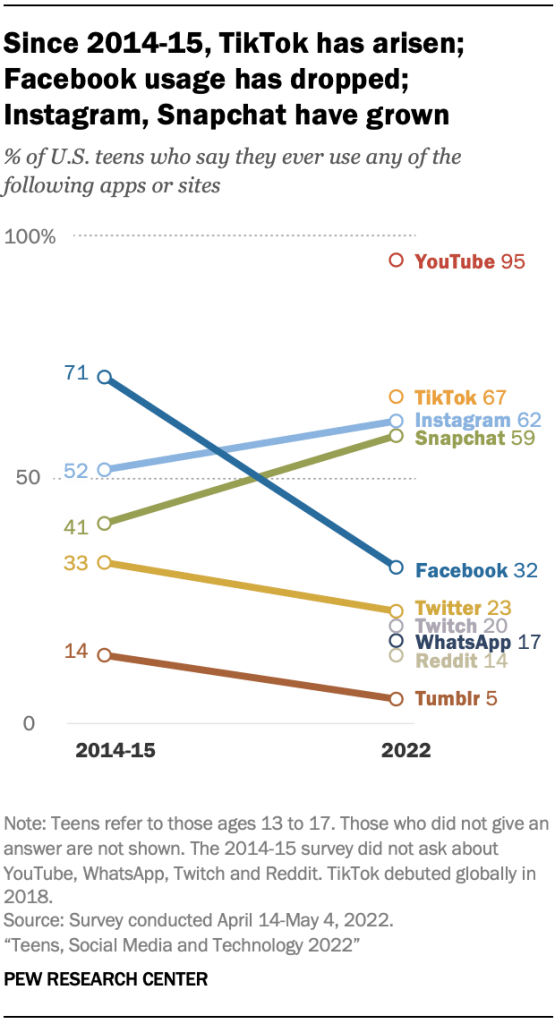
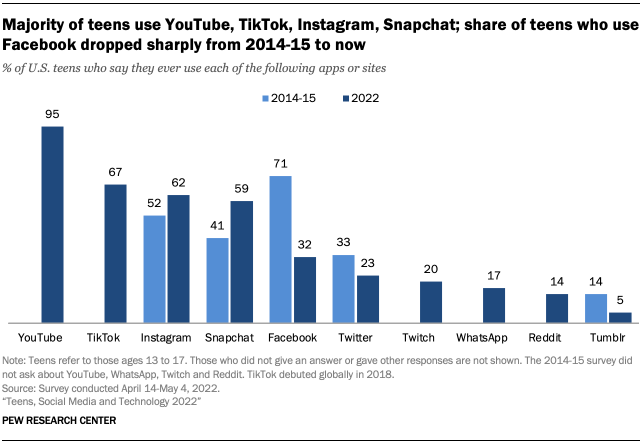
Teenagers are using TikTok (67%), Instagram (62%) and Snapchat (59%) more than other social media platforms to stay in touch with one another, according to the Pew Research Center. YouTube (95%) is their destination site for consuming media. Meanwhile, Facebook has lost most of its teen audience (from 71% in 2014 to 32%). The survey did not include chat and audio app Discord.

About a third of teens (36%) say they spend too much time on social media. Black teens were more likely to use TikTok while Hispanic teens were more likely than other groups to use WhatsApp. Read the details of the survey here and you’ll find a Washington Post article on the findings here.

How Science Fuels a Culture of Misinformation

Covid-19 hasn’t been just a viral pandemic, but also a pandemic of disinformation—what the World Health Organization calls an “infodemic.” Many scientists blame social media for the proliferation of Covid-related falsehoods, from the suggestion that Covid could be treated by drinking disinfectants to the insistence that masks don’t help prevent transmission. Facebook, Twitter, TikTok, and other platforms have indeed propagated dangerous misinformation. However, social media is a symptom of the problem more than the cause. Misinformation and disinformation often start with scientists themselves.

Joelle Renstrom writing in OpenMind

Local TV and Radio News Survey 2022

Takeaways from The Radio Television Digital News Association’s annual survey of local TV and radio:

Programming

  • A new record of 1,116 TV stations aired local news—up 18 from last year’s all-time high.

Budgets

  • Just 16.3% of TV stations report budget increases while 29.3% report experiencing budget cuts.

  • Among TV news directors who do know their department’s profitability, 75.9% report a profit.

  • The percentage of radio news managers reporting their budgets decreased doubled to 18.2% over the previous year.

Salaries

  • Despite pandemic-related pay cuts, local television news salaries, on average, increased by 3.5%, or 2.1% after accounting for inflation.

  • TV salaries in markets 101-150 faired the best, with salaries for most positions increasing while in the top 25 markets, salaries for most positions fell.

  • Average and median starting TV news salaries both rose during 2021 to the highest staring salaries in the survey’s history.

Staffing

  • Full-time newsroom staffing fell 6.3% in 2021.

  • Digital staffing, on average, was up slightly, along with the roles of photographer, producer, editor and social media producer/editor.

  • Three times as many commercial radio news departments cut staff as added. Public radio stations, on the other hand, were four times more likely than commercial stations to grow.

Solo Journalists

  • The average newsroom has fewer solo journalists than last year while smaller markets overwhelmingly rely on MMJs, and mid-markets increasingly do, but few stations large market stations send reporters out alone.

  • MMJs and producers remain most in demand, representing about three-quarters of new TV news hires.

Innovations

  • More local TV newsrooms report producing virtual town halls, specials and longer-form or digital-exclusive content.

Social Media

  • Facebook is the most popular social media platform for local TV and radio news, with 94% of radio newsrooms and 100% of TV newsrooms reporting they used it.

  • Instagram is used by nearly every TV station and a third of radio newsrooms.

  • Twitter use among local news has been declining for several years, with most TV newsrooms using the platform, but less frequently.

Podcasts

  • The typical station, measured by median, has no podcasts and the average per station is less than one half.

  • The typical radio news department reporting zero podcasts.

Danger

  • 1 in 5 television news directors reported attacks on employees.

  • More than half of attacks occurred during coverage of civil unrest, protests, marches/rallies or riots

The Full Report

19 Articles about Getting the Most out of LinkedIn

A Social Media Makeover (part 1)

(Answer the questions in blue)

PERSONAL BRANDING: A SOCIAL MEDIA MAKEOVER (PART 1)

Your online reputation is your reputation. Taking these steps will give you control of your social media brand. Companies want personal brands that run parallel to their own, not brands that compete with their social media reputation.

Google magnifying glass

 WHAT DOES GOOGLE KNOW?           

The first thing a prospective employer may do is Google you. So let’s find out who Google thinks you are.

Open an incognito browser window (so that your Google search is free from any personal customizations or saved search elements) and search for:

·       Your name, first and last (or the name of your business)

·       Variations of your name

·       Your full name, nickname, middle name, etc.

·       Any misspellings of your name

·       If your name is common, add other elements that might help define you like your occupation, your employer, your school, etc.

Are there inappropriate photos, rants, politically divisive or offensive items that do not fit with the brand you want to offer to the public and particularly to potential employers, clients or customers? This includes negative opinions about a company you’re about to interview with.

Tools to help you clean up your act (or keep it clean): Google Alerts and Socialmention. 

 YOUR NICHE

SET YOURSELF APART

What sets you apart from others? Here are some ways to get to an answer: 

·       What is the “one thing” that everyone says you rock at?

·       What are your passions and interests?

·       What do you read about most often online?

·       Will you still be interested in this particular area six months or a year from now?


YOUR HEADLINE

Keep it to 160 characters so it will fit into your Twitter bio.  For examples of what not to do (because some descriptions have been overused), check out the canned (and funny) TwitterBioGenerator.      

Think of it as a headline that would go on an ad for “Brand You.”  But remember: People want to connect with people, not a brand. It might be catchy and unique. Some examples:

 Consider loading it with keywords. Example:

Innovative CMO, Extensive retail experience from start-ups to major global brands. Fluent English, French, Mandarin

It might be a power statement that defines your personal brand. Example:

Helping Companies Find Breakout Ideas and Transforming Them Into Global Technology Brands

The best profiles tell a story, a career story or a personal story. Something that ties all the pieces of your journey together in a narrative.

If you are focused on job hunting, look at job descriptions of the positions you’re after. Look for keywords and treat them like your resume.

Aim at somewhere between 450 and 650 characters.

Walk the reader through your work passions, key skills, uniqueness.  Include the skills you want to be known for.

Consider including:

·       One professional description (your bio should be accurate)

·       One word that is not boring (your bio should be exciting)

·       One niche descriptor (your bio should be targeted)

·       One accomplishment (your bio should be flattering)

·       One hobby (your bio should be humanizing)

·       One interesting fact or feature about yourself (your bio should be intriguing)

·       Your company or another social profile (your bio should be connected)

       Avoid:

·       Insider jargon

·       Clichés

·       Overused buzzwords (such as creative, driven, innovative, hardworking etc.)

·       General statements (Be specific. When possible, include numbers and case studies that prove success)

Write as if you are having a conversation with someone. Inject your personality.


MULTIMEDIA ELEMENTS 

Slides, videos, infographics, photos--photos you have taken or photos of you doing things?

If you’re in a creative field, there’s no better way to flaunt your personality, design aesthetic, and vision than through a personal social media profile.

Ask yourself this: Based on what I post, do I look like I’d be awesome to work with?  

The algorithmic feedback loop

Users keep encountering similar content because the algorithms keep recommending it to us. As this feedback loop continues, no new information is added; the algorithm is designed to recommend content that affirms what it construes as your taste.

Reduced to component parts, culture can now be recombined and optimized to drive user engagement. This threatens to starve culture of the resources to generate new ideas, new possibilities. 

If you want to freeze culture, the first step is to reduce it to data. And if you want to maintain the frozen status quo, algorithms trained on people’s past behaviors and tastes would be the best tools.

The goal of a recommendation algorithm isn’t to surprise or shock but to affirm. The process looks a lot like prediction, but it’s merely repetition. The result is more of the same: a present that looks like the past and a future that isn’t one. 

Grafton Tanner, writing in Real Life Magazine

New Adobe tool for Content Creators

Adobe express logo

Adobe has released a single template-focused app called Creative Cloud Express (replacing Adobe Spark) that combines some of the best features from the Creative Cloud Suite for mobile and web. Quickly create everything from social media posts to promotional posters and videos with an easy-to-use drag-and-drop interface. Drag all sorts of elements into your composition from text, icons, shapes, free photos and fonts, music and other design elements. Assets from Photoshop and Illustrator can be utilized as well. Convert videos to GIFs and documents to PDFs. Great for non-professionals with little video editing experience. However, if you’re a pro, this is not a full-featured video editor.  

Creative Cloud Express includes premium features from: 

  • Adobe Premiere Rush — Shoot, edit, and share videos on mobile and desktop. 
  • Adobe Photoshop Express — Edit and retouch images, create collages, and combine photos. 
  • Adobe Spark Video — Quickly create stunning video slideshows. 
  • Adobe Spark Page — Turn words and images into beautiful web pages.

More on the features here.

Teaching resources from Adobe for Educators here.

While Express is already included in many Creative Cloud subscriptions, there is a free version available or get more templates, photos and fonts with a paid subscription for $9.99 a month (or $99.99 a year) here. Better yet, there is a three-month free trial here. More info on the plans here.

More Tech Tools

Are we immune to manipulation?

We like to think of ourselves as independently minded and immune to manipulation, and yet imagine others — particularly those of a different political persuasion — as being fantastically gullible. The reality is probably something in between. 

We do know that the posts we see on Facebook have the power to alter our emotions. A controversial experiment run by Facebook employees in 2013 manipulated the news feeds of 689,003 users without their knowledge (or consent) in an attempt to control their emotions and influence their moods. The experimenters suppressed any friends’ posts that contained positive words, and then did the same with those containing negative words, and watched to see how the unsuspecting subjects would react in each case. Users who saw less negative content in their feeds went on to post more positive stuff themselves. Meanwhile, those who had positive posts hidden from their timeline went on to use more negative words themselves. Conclusive: we may think we’re immune to emotional manipulation, but we’re probably not.  

Hannah Fry, Hello World

The Social Media Distraction

I think the reason that we seek distraction (from social media) is that working on stuff that we care about is often scary. It brings us into contact with all the ways in which we’re limited—our talents might not be up to what we’re trying to do, and we can’t control how things will unfold. If you’re writing a difficult article, you don’t get to know in advance that it’s going to come out well, which can make you feel constrained and imprisoned by reality. Meanwhile, the internet feels limitless, like you’re an all-powerful consciousness surfing the unlimited waves of the web and social media. It’s very relieving.

Oliver Burkeman quoted in The Atlantic