Going Back
/I learned ... that one can never go back, that one should not ever try to go back - that the essence of life is going forward. Life is really a one-way street, isn't it? - Agatha Christie (born Sept 15, 1890)

Ideas that challenge / comfort / inspire
Stephen Goforth
I learned ... that one can never go back, that one should not ever try to go back - that the essence of life is going forward. Life is really a one-way street, isn't it? - Agatha Christie (born Sept 15, 1890)
Students who use AI tools to complete assignments tend to do better on homework—but worse on tests. They’re getting the right answers, but they’re not learning. The findings suggest that simply believing information came from an LLM makes people learn less. It is like they think the system is smarter than them, so they stop trying. That’s a motivational issue, not just a cognitive one. AI doesn’t have to make us passive. But right now, that’s how people are using it. -Wall Street Journal
When caught lying (paternalistically or otherwise), people often defend themselves by saying they lied to protect the other person. But before lying to protect someone’s interests or feelings, ask yourself not only whether you are lying to protect them, but also whether that person would believe your lie was well-intended if they found out. In several studies, we found that people were not likely to believe paternalistic lies were well-intended, and reacted poorly to these lies even when the liar communicated good intentions. However, people were more likely to believe that paternalistic lies were well-intended when they were told by people who knew them well or had reputations as helpful, kind people.
Even though paternalistic lies are often well-intentioned, if uncovered, they will usually backfire. Lying may be helpful when there is no ambiguity about the resulting benefits for those on the receiving end. But in most other circumstances, honesty is the best policy.
Adam Eric Greenberg, Emma E. Levine, Matthew Lupoli writing in the Harvard Business Review
I’m personally excited about AI and think it can improve our lives in a lot of ways. But at the same time I’m trying to be mindful of secondary effects and unintended consequences. Sometimes the friction and inconvenience is where the good stuff happens. Gotta be very careful removing it. I’m personally trying to be mindful about keeping good friction around. -Geoffrey Litt
The squeegee of window washer Jan Demczur is in the Smithsonian. His determination and willingness to use what was handy on the morning of September 11, 2001, put it there.
The Polish immigrant was riding in a north tower World Trade Center elevator when a hijacked plane hit the building. The elevator came to a stop on the 50th floor. That's when Demczur and other stranded workers pried open the door, revealing a solid wall.
Rather than give up, Demczur used his brass squeegee handle to hack away at it. He eventually broke through the wall and led the group to safety just moments before the tower fell.
Got a wall to break through in your life? There's probably a tool at your disposal. Work with what you've got and refuse to give up.
Stephen Goforth
If you can say you worked a job where you had to show resiliency and adaptability, those are things that employers are looking for. We are individuals with unique experiences, unique energy and unique resilience. That's what we're going to get hired for. – Aneesh Raman, chief economic opportunity officer at LinkedIn https://www.bbc.com/worklife/article/20250825-aneesh-raman-young-people-employment-opportunities-katty-kay-interview
Whenever possible, express your feelings about offensive behavior from a positive rather than a negative perspective. Negative expressions state your dislike, as in “I hate you when you do that,” “You make me angry,” “You make me feel insecure and unloved,” or “You’re insensitive and overbearing.” You can be more effective if you focus on the common goals and the shortcomings of the interaction, rather than your hatreds.
Goal oriented statements might be, “I think that your behavior and my reaction to it are preventing us from having a pleasant relationship.”
You might try new ways to express your feelings, using metaphors on describing the concrete aspects of your emotional reactions. Thus you might express embarrassment by the metaphor “I feel naked and exposed,” or express conflict by “I feel my head spinning in two directions at once.” Striking metaphors may produce a greater impact than the accustomed “emotional words” that have been worn out in your interchanges with others.
Sharon and Gordon Bower, Asserting Yourself
"Using AI well will require knowing when to automate versus when to collaborate. This is not necessarily a binary choice, and the boundaries between human expertise and AI’s capabilities for expert judgment will continually evolve as AI’s capabilities advance. Although collaboration is not intrinsically better than automation, premature or excess automation—that is, automation that takes on entire jobs when it’s ready for only a subset of job tasks—is generally worse than collaboration." -David Autor and James Manyika writing in The Atlantic
It is amazing how complete is the delusion that beauty is goodness. -Leo Tolstoy (born Sept. 9, 1828)
When you use ChatGPT, Claude or Llama technology within DuckDuckGo’s chatbot, the company acts as a middleman that limits what the AI companies know about you and what you’re chatting about. DuckDuckGo says that when you use its chatbot, your conversations aren’t used to train AI for DuckDuckGo or any of its partner AI companies. Your chats may be saved only anonymously for, at most, 30 days, with limited exceptions. And the AI companies don’t have access to personal information such as your device’s unique digital ID number, which could be used to assemble dossiers on your habits. -Washington Post
The Wall Street Journal explains how it put together a “strikingly realistic” short AI video using Google’s Veo 3 and Runway can now create video.
A few years ago, I saw a cartoon of a man on his deathbed saying, “I wish I’d bought more crap.” It has always amazed me that many wealthy people keep working to increase their wealth, amassing far more money than they could possibly spend or even usefully bequeath. One day I asked a wealthy friend why this is so. Many people who have gotten rich know how to measure their self-worth only in pecuniary terms, he explained, so they stay on the hamster wheel, year after year. They believe that at some point, they will finally accumulate enough to feel truly successful, happy, and therefore ready to die. This is a mistake, and not a benign one.
Arthur C. Brooks writing in The Atlantic
It is not strength but desire that moves us.
"A truth about today’s AI tools: They’re not really information experts. They have challenges determining which source is the most authoritative and most recent. It’s fair to ask whether relying on any of these AI tools as your new Google is a good idea. In many ways, AI is best suited for complex questions that take some hunting. In the best cases, AI tools could find needles in a haystack — answers that weren’t obvious in a traditional Google search." - Washington Post
American Society of Business Publication Editors
American Society of Journalists and Authors
The Arab and Middle Eastern Journalists Association
Arab Reporters for Investigative Journalism
Asian American Journalists Association
European Federation of Journalists
Global Investigative Journalism Network
Indigenous Journalists Association
The Institute for Independent Journalists
Investigative Reporters and Editors
The Journalists and Writers Foundation
Military Veterans in Journalism
National Association of Black Journalists
National Association of Hispanic Journalists
NLGJA: The Association of LGBTQ Journalists
Public Media Journalism Association
Radio Television Digital News Association
Society for Features Journalism
Keep turning the pages that need to be turned. -Angel Chernoff
A recent graduate triple-majored in computer science, math, and computational science and has completed the coursework for a computer-science Ph.D. He would prefer to work instead of finishing his degree, but he has found it almost impossible to secure a job. “We’re in an AI revolution, and I am a specialist in the kind of AI that we’re doing the revolution with, and I can’t find anything.” -The Atlantic
We "sell out" whenever we fail to take ownership of who we are. It's much easier to default to the expectations of friends/work/society/church rather than taking responsibility for our thinking and actions. Turning control over of what we have been entrusted with to someone (or something) else is an attempt to take the responsibility off our shoulders, so there’s someone else to blame.
“We have started seeing employers saying things like, 'If you have that computer science degree, do you have a philosophy minor so you can help me think about the ethical implications of what I'm building?'” – Aneesh Raman, chief economic opportunity officer at LinkedIn
A group of librarians tested AI search tools for accuracy. Here’s the results:
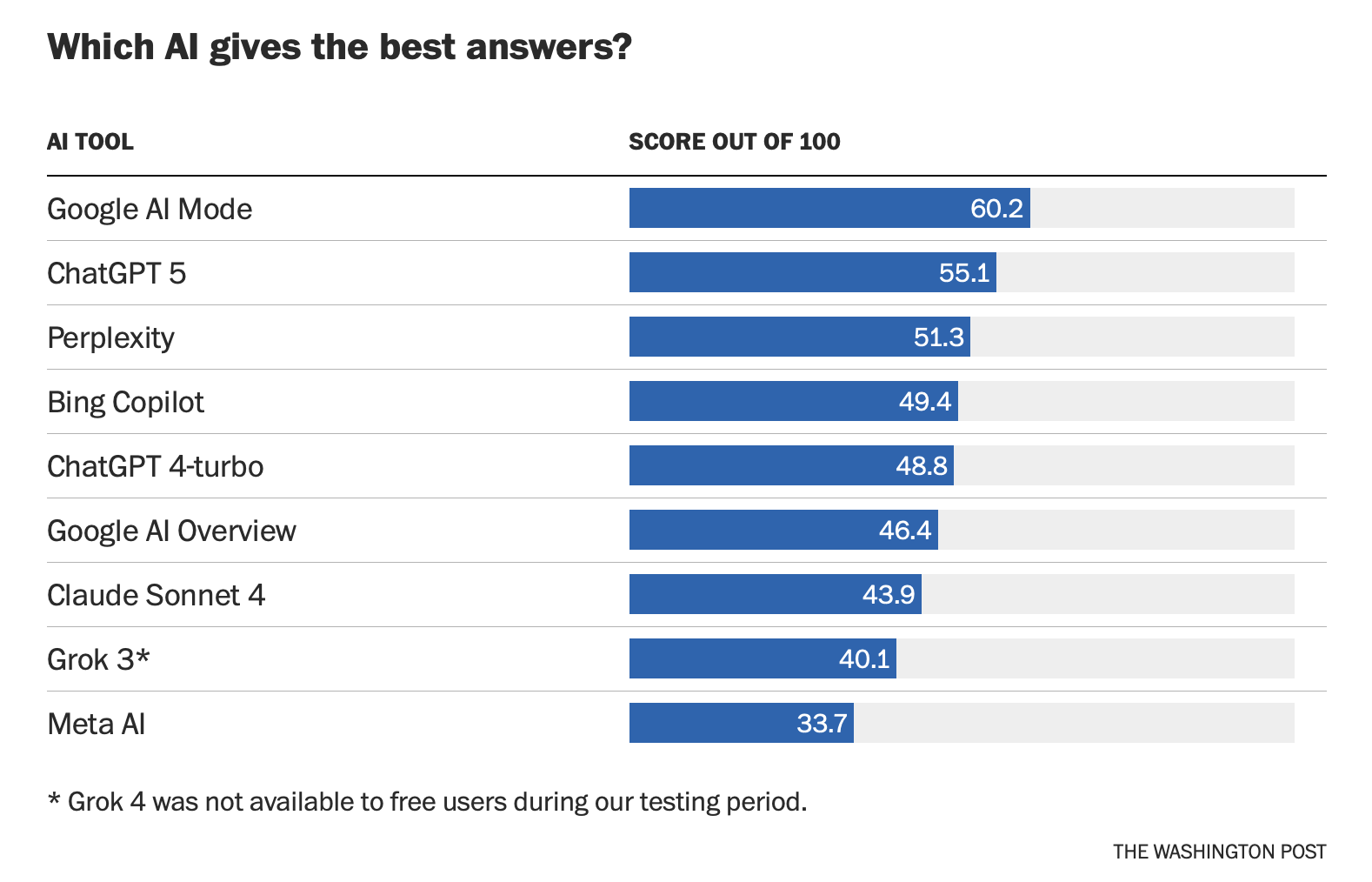
Read more at The Washington Post
Becoming is a service of Goforth Solutions, LLC / Copyright ©2026 All Rights Reserved